
Fair warning: this blog post is a bit longer than the others, and I expect longer than any future blog post I will publish on this trip.
—————–
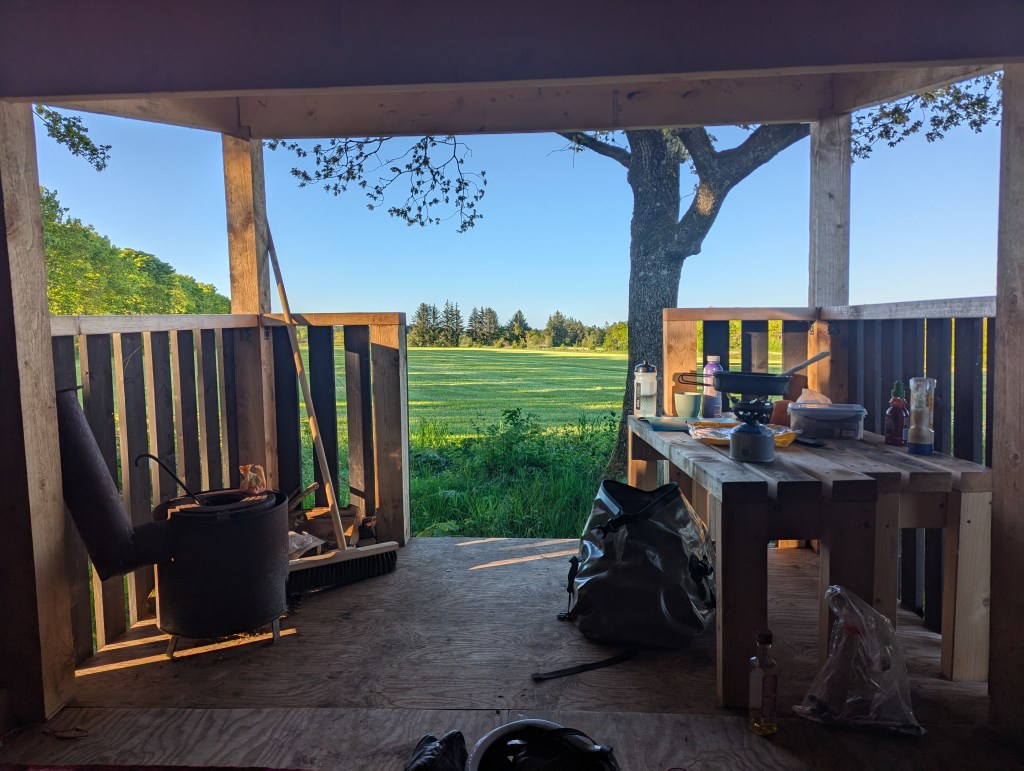
Have a search for “shelter” on Google Maps in your local area. If you live in the UK or USA, the results will generally yield temporary accommodation provided by local authorities, charities and religious groups in the support of the homeless. Run the same search in Denmark and the results will look a little different – smaller, more wooden, usually in the middle of nowhere – like sheds in a field.
I heard about Denmark’s network of shelters online a few years ago and was intrigued by the concept. My memory was that they are small wooden buildings where you can rock-up and sleep for the night free of charge, a bit like a bothy in Scotland, although I’d never met anyone who had stayed in one until my hostel buddy in Bremen gave them a solid thumbs up. Despite the recommendation I still had lingering reservations about one side of my sleeping quarters being wide open to the wind, insects, and early morning dog walkers – nonetheless, I decided a key mission for Denmark was to give the shelters a proper go.
The first steps into Scandi
As I was packing up my tent at the forest Trekkingplätze, the morning serenity was punctured upon arrival of several groups of tweens who had been staying at the nearby forestry school. All quite civilised and well behaved when their teacher was around keeping tabs on proceedings, but when a group returned unaccompanied the dynamic soon changed – within minutes one of the boys chucked a girl’s sandal into the pond which promptly sank to the bottom; without hesitation the girl struck back, swiftly grabbing the boy’s recently removed t-shirt and lobs it into the water. After a heated exchange the boy took off his shoes, rolled up his trousers and waded into the pond to seek out the submerged garments.
As the only adult in attendance and feeling increasingly like Victor Meldrew, I wondered where you draw the line and intervene in the antics of youth. Nothing wrong with a bit of goofing around, and the kids who were at each other’s necks one minute seemed to be sitting and chatting the next. I concluded as long as nobody is actively throwing punches or trying to drown each other, then it gets a pass from me.

After a swift getaway from the Lord of the Flies I was at the border and across into Denmark in less than 30 minutes. Needing to pick up a few groceries I headed for the nearest decent sized town, Tønder.
Within seconds of crossing the river at Tønder you are into the old town centre. Not dramatically different to Germany on first impression, but the buildings seemed to be more colourful with a different architectural twist, and the public artwork (like the lotus flower fountain in the river) had a distinctive style that did not feel German to me.

Whilst dragging out a cappuccino in a local café I downloaded the ‘Shelter’ app that my roommate had recommended back in Bremen. The app has an interactive map with each shelter marked with an orange pin. When you first log in, the map is quite zoomed out, and the entire country of Denmark is a sea of orange – there really are a lot of these things about. I zoomed in to the area north of Tønder and began to rummage through my options.
My first misconception was that all shelters are free and allocated on a ‘first come, first serve‘ basis – some of them are like this, but well over half can be booked in advance, and most do cost money. But with the going rate coming in at £3.30 a night I wasn’t going to grumble, and I liked the idea of guaranteeing a spot, so I booked one around 10km away along a gravel track not far from the sea.
Shelter No.1 – the friendly neighbours

I arrived to find one of the shelters occupied by a couple who were clearly on a cycle tour of their own, only they were bravely doing it on a tandem! The shelters themselves were fairly big and chunky by design, and you could easily get four adults in there, more if you like to be cosy.
One nice feature about the Emmerlev shelters is you can spin them around to face away from the wind, although a light breeze did still make its way through between the boards underneath from time to time. They had your basic amenities of drinking water and a composting toilet, plus a firepit with wood that could be purchased using your phone.
But what defined this shelter was the fact I had neighbours, Maarten and Willemijn from the Netherlands. We got talking and soon realised the three of us were sheltering for the first time, which broke the ice. Their planned destination was Europe’s most northern tip – the Nordkapp – well within the arctic circle, which explained the cosy looking sleeping bags laid out in their shelter which I was feeling a little jealous of.
My neighbours had a bit more touring experience compared to me and were kind enough to share some of their wisdom – I especially liked the elasticated netting with hooked edges they use on top of their rack bag: you can quickly stuff a jacket underneath the net without the rigmarole of unstrapping, opening, closing, and re-strapping your rack bag – a massive time saver! They also gave me some advice on my wobbly front panniers, which I had failed to secure properly to the rack.
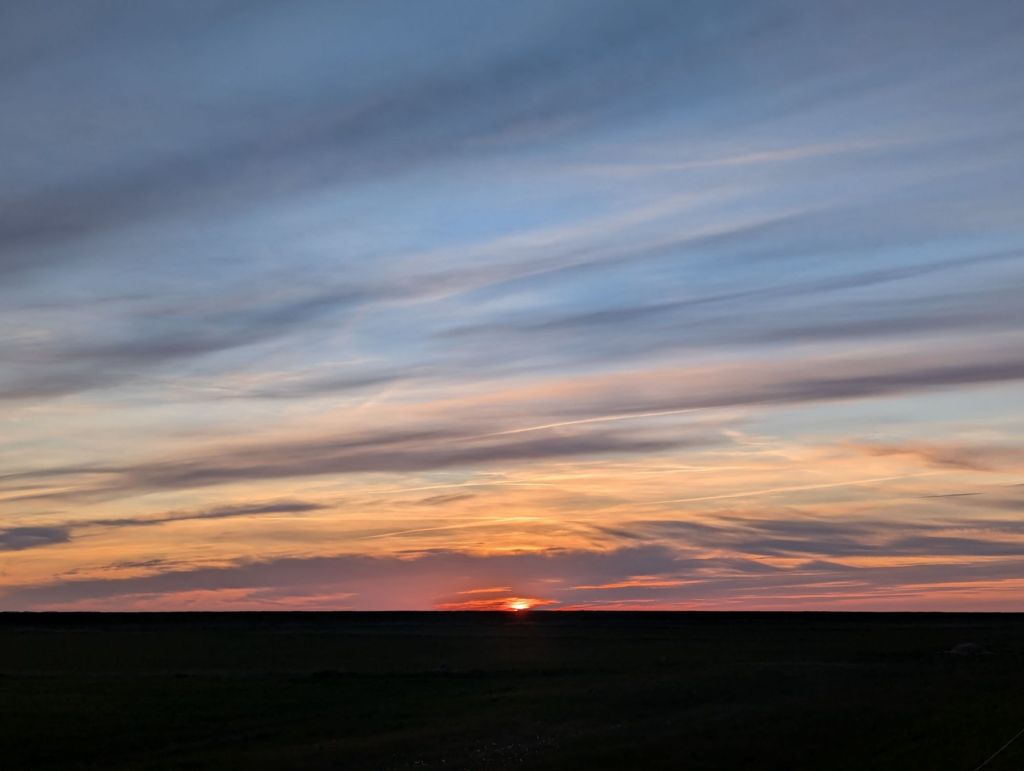
The sun lowered itself into another spectacular retreat and we settled down into our respective shelters. The floor was coated in a layer of wind-blown soil dust, so I laid down the groundsheet of my tent to protect the airbed, sleeping bag and inflatable pillow. It was certainly a strange feeling to be exposed to the elements on one side; although the walls of a tent are paper-thin it’s amazing how secure and protected you feel once curled up inside. I was chatting with Maarten the next morning and he felt like the shelter sleep was lighter than in a tent, but yet he said he felt remarkably refreshed. It was similar for me: although you wake up in the night more often, there’s something about opening your eyes after a cycle of REM – that moment when you piece reality back together from the confusing kaleidoscope of a night of dreams – and seeing dawn unfold in front of you, that just makes you feel, good.
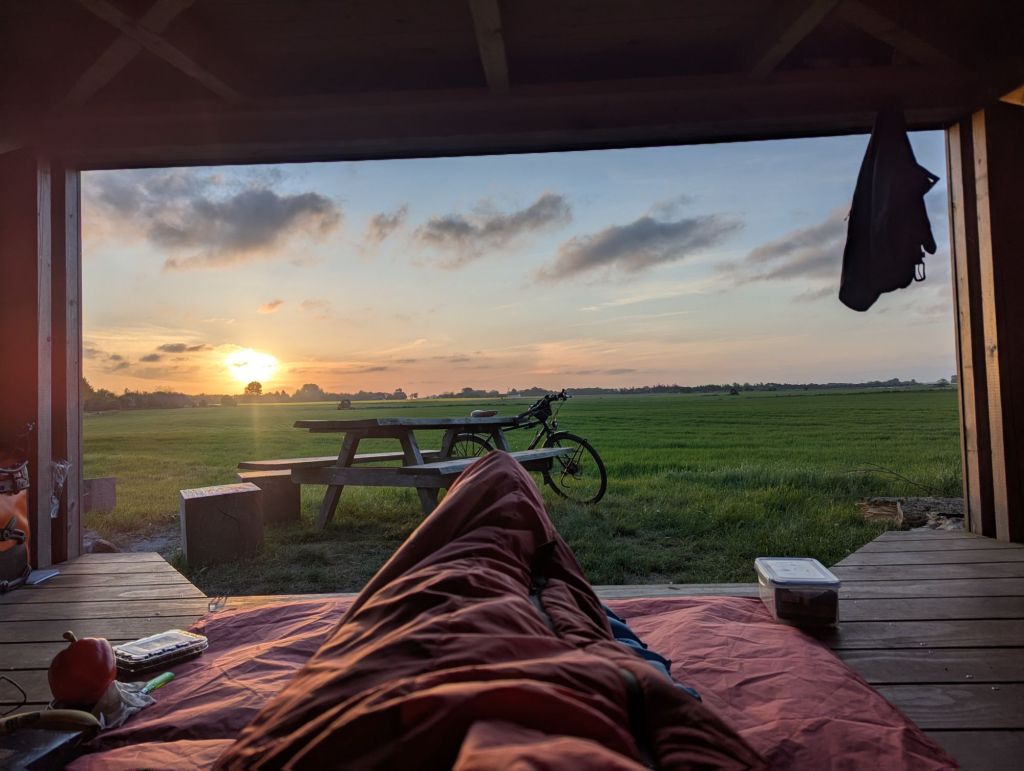
It was very much a positive first-time shelter experience, and it gave me confidence to try out a few more as I made my way across Denmark. The question now was, which way should I go?
After chatting with Maarten and Willemijn about how they like to tour I realised the importance of keeping things flexible and making sure to do things I enjoy, and I was becoming curious to see a bit more of Denmark than just the western region of Jutland. That was the moment I made the first major divergence from my original route – instead of straddling the west coast of Jutland and taking a ferry to Norway from the northern port of Hirtshals, I would now head east to Copenhagen, via the island of Fyn. I could figure out how to get from Copenhagen to Norway another day.
Getting a wash
As I set off on my slightly more loosey goosey way, there was a feeling that had been creeping over me that was now becoming hard to ignore; I was starting to get a bit manky.
My last proper shower was four days prior and the weather had been warm and sweaty, I needed that refreshing feeling of water against my skin, even if it wasn’t as luxurious as a warm shower. I checked the Shelter app for any nearby with a shower, but no luck. Instead I booked a woodland shelter located a little further north towards the historic town of Ribe, and decided to spend my afternoon exploring the island of Rømø…maybe there would be a shower there?
You can get to Rømø from the mainland by travelling along the Rømødæmningen, or Rømø dam, a 9km raised embankment not unlike the one I rode across in the Netherlands, except this time against a disgusting headwind. The road was dead straight and the speed slow. After a while my eyes began to play tricks on me, it was as if the world around me was being slowly ejected from a small dot in the centre of the horizon, like some kind of inexplicable Danish black hole. The more I stared into the dot the more my sense of perspective distorted, I was losing all sense of depth perception – the scene in front of me was reduced to a flat canvas of straight lines radiating from the black hole. I was like a hamster in a wheel, getting nowhere.
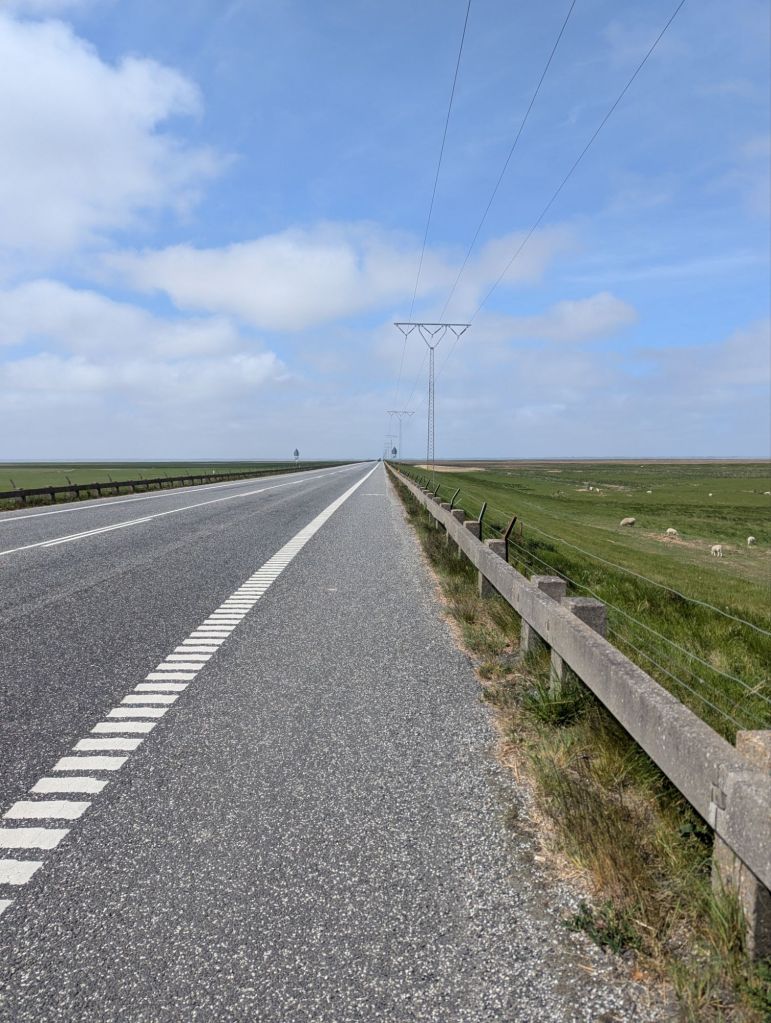
There are lots of little tactics you can employ to stop yourself going insane on a bicycle, or at least delay the onset. On this occasion I tuned into the fact there was a finite number of pylons between me and the shore: each tower passed was a moment to be celebrated – “ONE PYLON CLOSER!”. The aim is to take the seemingly colossal task that lies before you and break it into bitesize chunks, and it works both in the saddle as well as off the bike (e.g. you might be better off thinking about the tour and what lies ahead in sections, rather than in totality).
After a brief wander around the tourist shops and cafes of Lakolk I decided to go and check out the massive beach that dominates the western shore of Rømø. And massive it is. I’ve not come across many beaches where the public are allowed to drive on, but here it was allowed, so the shifting landscape was littered with the oversized campervans of people who wanted a nice view of the sea without the long walk. I actually managed to ride my bike for a while where the sand had been compacted, before eventually succumbing to the lack of friction and pushing it to a solitary wooden post a stone’s throw from the water’s edge.
I’m not sure of the exact moment I decided to hurl myself into the sea. I looked around and couldn’t help but notice not a single other person was bathing, even though it was a sunny day. Finally I saw a chap head out into the waves for a session of kite surfing, which was all the encouragement I needed.
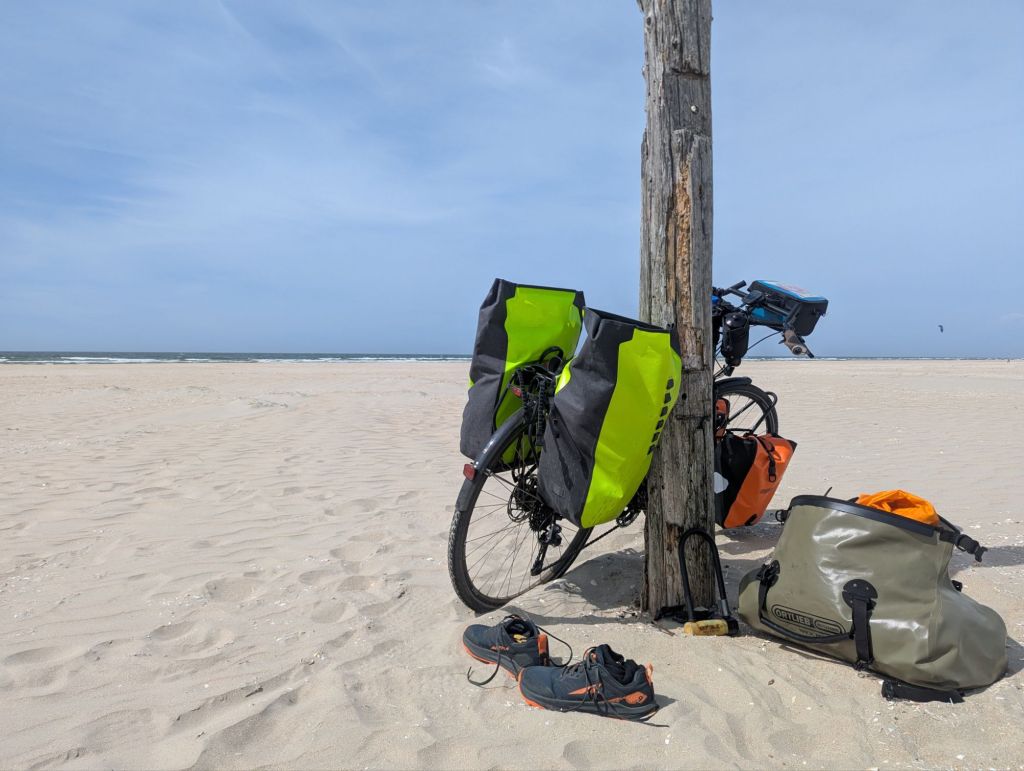
The water was shallow and the waves quite gentle, so shallow it wasn’t really possible to swim without walking right out to sea (which I didn’t fancy), so I gracefully squatted down and let the sea water do its thing. I don’t know how often you jump in the sea, but I honestly couldn’t believe how soft my skin felt afterwards, and the perennial patch of dry skin above my left eyelid seemed to dissolve in the brine. It might not have been a warm shower but the manky feeling was gone.
Shelter no.2 – the woods
I knew the shelter I would be staying at that evening did not have electricity (most don’t), so I swung by Cafe Retro in the nearby village of Brøns to charge my phone and concede defeat to the world’s largest bowl of chips.
The shelter was one of three nestled in a patch of woodland on the eastern edge of Brøns. The other two were unoccupied leaving the whole site to myself, including full reign of the firepit. The shelter was a bit more solid than at Emmerlev, and although there was no way of turning it around it didn’t really matter amongst the wind-shielding trees, and besides the evening was still, dry and peaceful. It also had a lower roof, so vigilance required to avoid a head whacking.
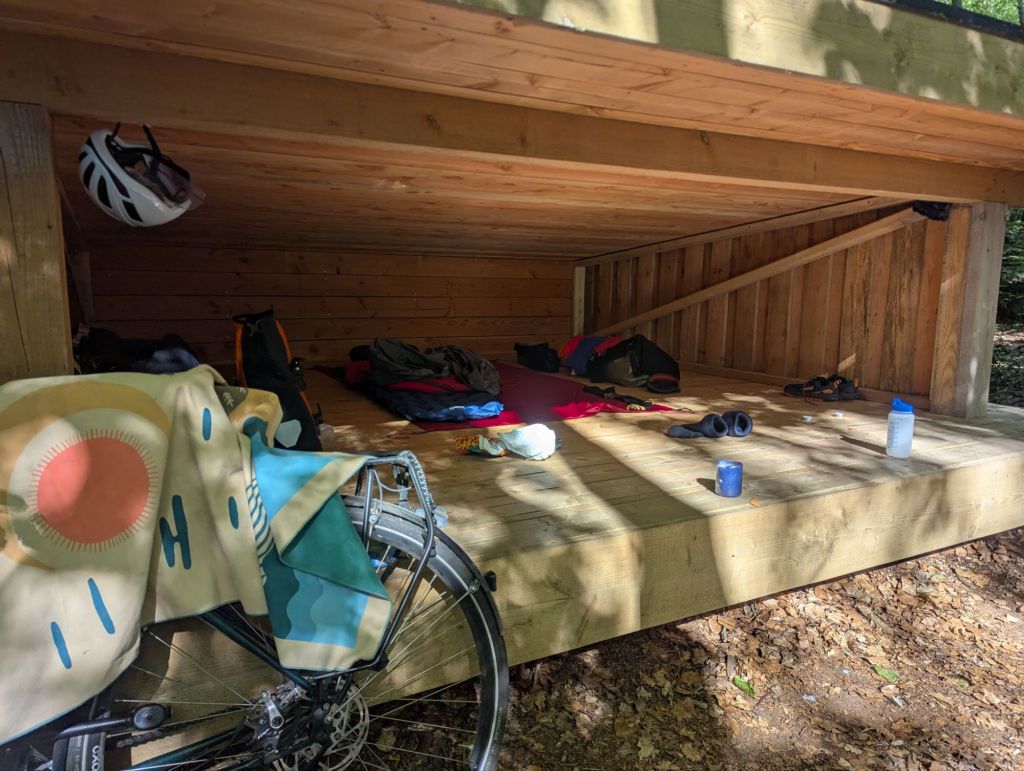
I spotted a large sweeping brush so decided to give mine a spring clean before unloading my gear. It felt a bit more homely after a good sweep, topped off by lighting a few of the candles that had been left in the corner. It might sound sketchy lighting candles in your combustible wooden shed bed, but the real fire risk is from the firepit to the surrounding woodland.
The shelter owners had provided a pile of firewood in the corner of the site, and there was plenty of kindling around, so after checking the local fire brigade website for any local warnings (or bans) I lit a small campfire with a primitive device fashioned out of two sticks my lighter.
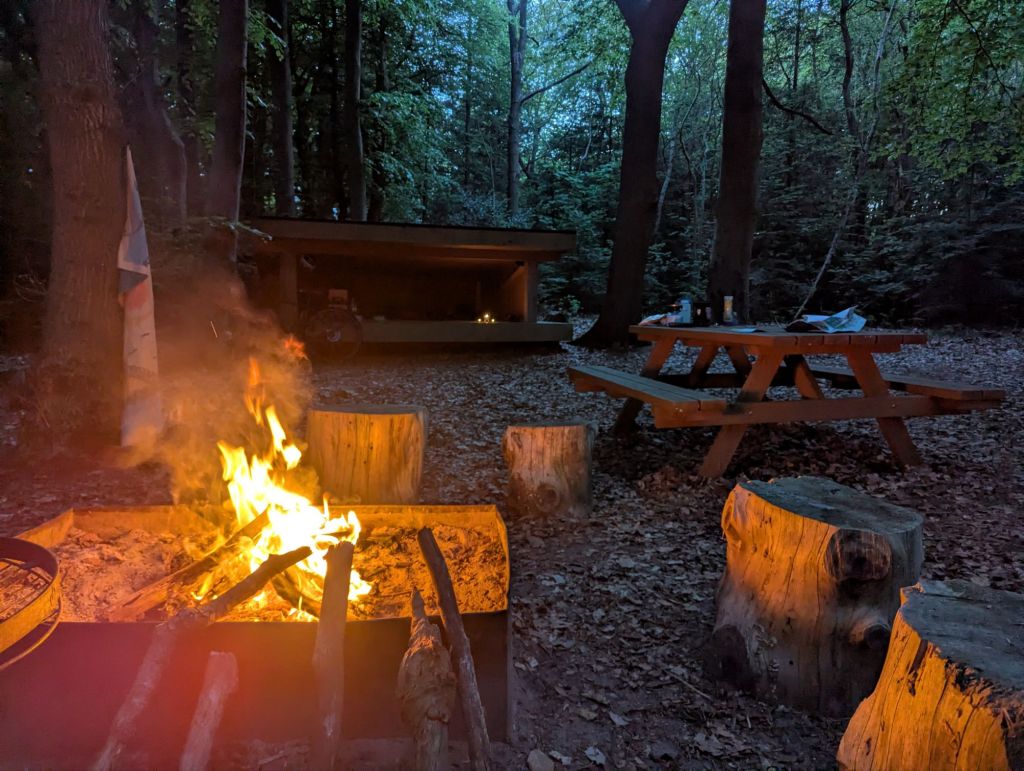
You definitely need a bit of extra vigilance with fires in the woods, mainly to keep an eye on the wind, make sure the fire doesn’t get too big or start belching out hot embers, and to put it out before you go to bed. If you do hear a big pop and see a hot ember shoot out, make sure it hasn’t gone rogue in starting a little fire of its own.
It felt like a milestone to get my first fire going. The warmth, the soft crackles, the trance inducing flames, even the smell is appealing (even if it does linger on you for days). I don’t plan to have a lot of them, so I want to savour the ones I do.

Shelter No.3 – the Shire
After a night camping next to a field of red deer in someone’s back garden (…with permission) and a morning spent mooching around the clean but unremarkable city of Esbjerg, I began to head east into the heart of Jutland.
It felt good to be going a different compass direction for a change, yet not so good on the legs as I was now ploughing directly into another headwind. Touring bikes are a bit like boats when it comes to wind, you will glide along effortlessly when the wind is in your sails, but when it’s against you the going gets real tough real quick, and you just have to accept it will take a lot longer to progress now.
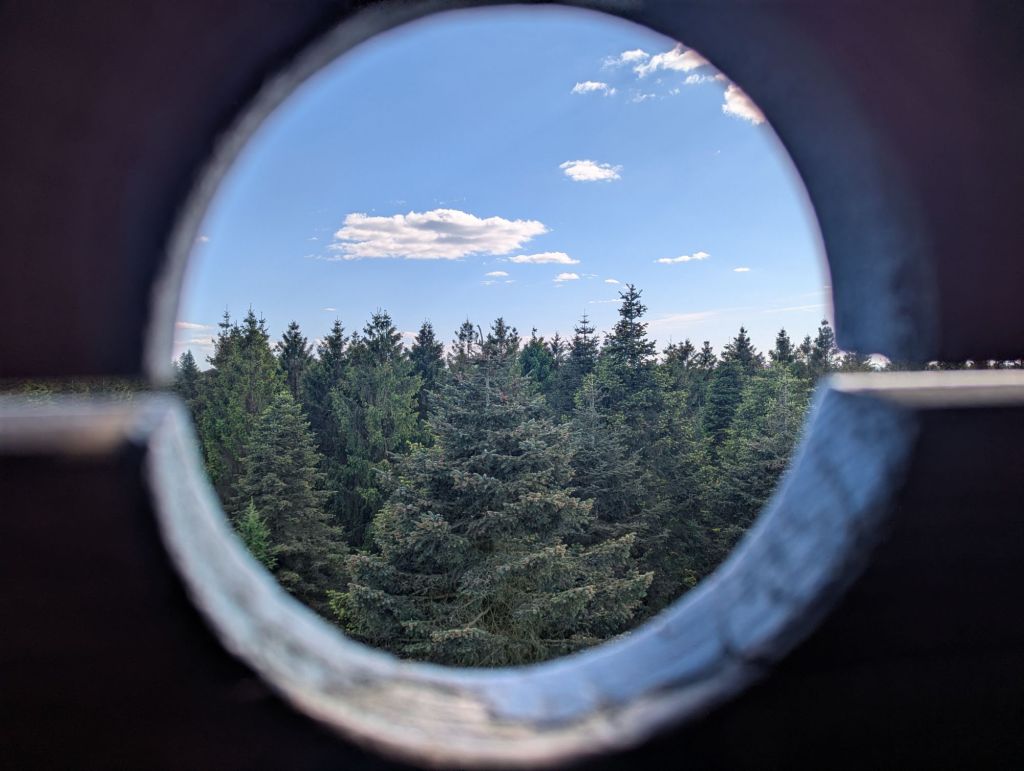
There were slightly less shelter options inland compared to the coast, but I managed to secure a booking at a remote looking standalone shelter around 15km south of the city of Legoland Billund. As I moved deeper into the country the farmland began to give way to pine forest plantations, and I had took a short break to climb a bizarre looking viewing platform. You don’t really get these things in the UK, and especially not ones with a wooden prism at the top with ladders inviting you to climb up to several small viewing portholes. Sound dangerous? It was, a bit.
The asphalt roads gave way to gravel, which slowed me down further. It really did feel like I was beginning to stray from civilisation, at least as much as you can in a small country like Denmark. I reached the dead end road leading to my accommodation and by chance met the owner and his son in a car on their way out for the evening.
“The farmer will be spreading tonight. Spreading er, how you say…”
“Shit?”
“Yes! But you know, animal shit. You get used to it quite quick. He does it once a year and there’s no stopping him, I’m sorry!”
I did think he could maybe have mentioned this detail in our email exchange, he had no financial incentive not to: the shelter was provided free of charge. I wished them well on their way to wherever they were escaping the evening’s muck spreading and located a somewhat shaky looking shelter standing precariously close to the edge of a field.
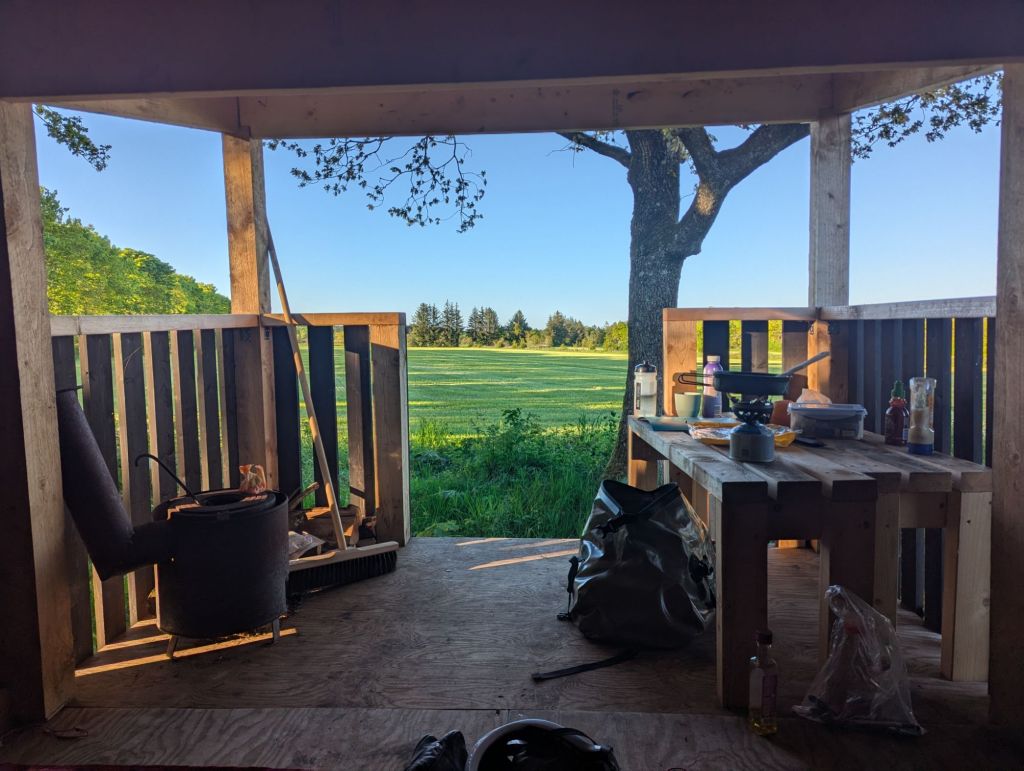
The shelter was built on top of an old trailer, with the entrance suspended a good two feet from the ground with no steps. There was a large nail protruding from the wooden beam overhanging the entrance, and potential splinters lurked everywhere. However, this was one the best evenings I’ve had enjoying the outdoors that I can remember.
There was something about the remote location, along with perfect weather conditions and having plenty of food and drink. The inclusion of a little seating area within the shelter was a nice touch, and there was even a metal stove that I didn’t dare to use. It was shabby, but it had charm and the location to compensate. Just please don’t rent this shelter if you use a wheelchair for heaven’s sake. And thank you Mr Farmer man for not spreading the field directly next to me, whether this was an act of mercy or otherwise.
Shelter No.4 – Going upmarket
I continued my journey east aiming for the narrow strait of water separating Jutland and the island of Fyn, known as the Little Belt. With the weekend upon me all the good shelters had been booked up – you have to get in early if you want a weekend slot at the popular shelters – so I pitched up at a ‘primitive campsite’ near the Old Little Belt Bridge, which turned out to be a field with instructions on where to find the nearest public bogs.
The next morning I crossed the bridge and headed south east along the coast towards the town of Assens. There seemed to be a lot of shelters in this area and with it now being Sunday I could pick whichever one I fancied. I opted for the Aborg Mark shelter site that offered a lot in the way of amenities, maybe I could wash my clothes in an actual washing machine?
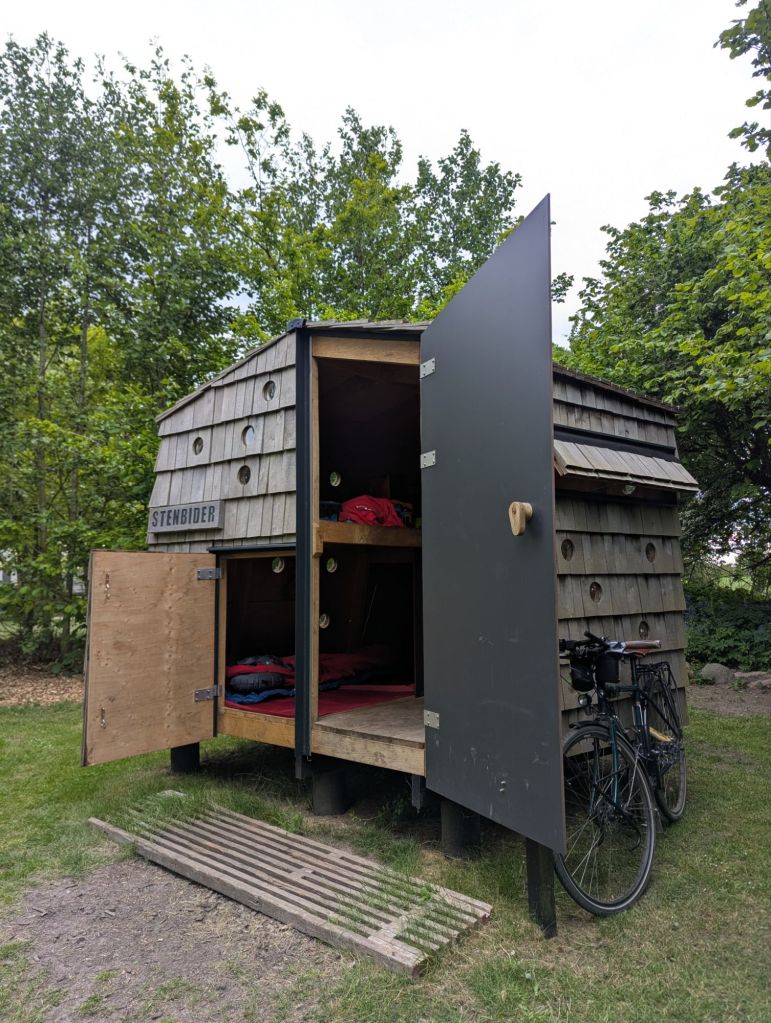
Just look at that thing: it has multiple doors into various compartments, adjustable air vents, porthole windows, and the bottom sleeping compartment has a sliding internal door to separate you from the non-closeable aperture which is just out of shot in the photo, so you are fully cocooned from the elements.
The site is a real 5* experience as far as shelters go. There is a central heated communal area with kitchen, toilets, a shower, power sockets, washing machine and a selection of long life groceries, all payable through the honesty box. I did have to pay the two person minimum rate for my beehive shelter (not uncommon) but still only around £6.50 a night. I do understand the 2-person minimum charge, but I feel like it could be waived or partly refunded if there are other empty shelters that night.
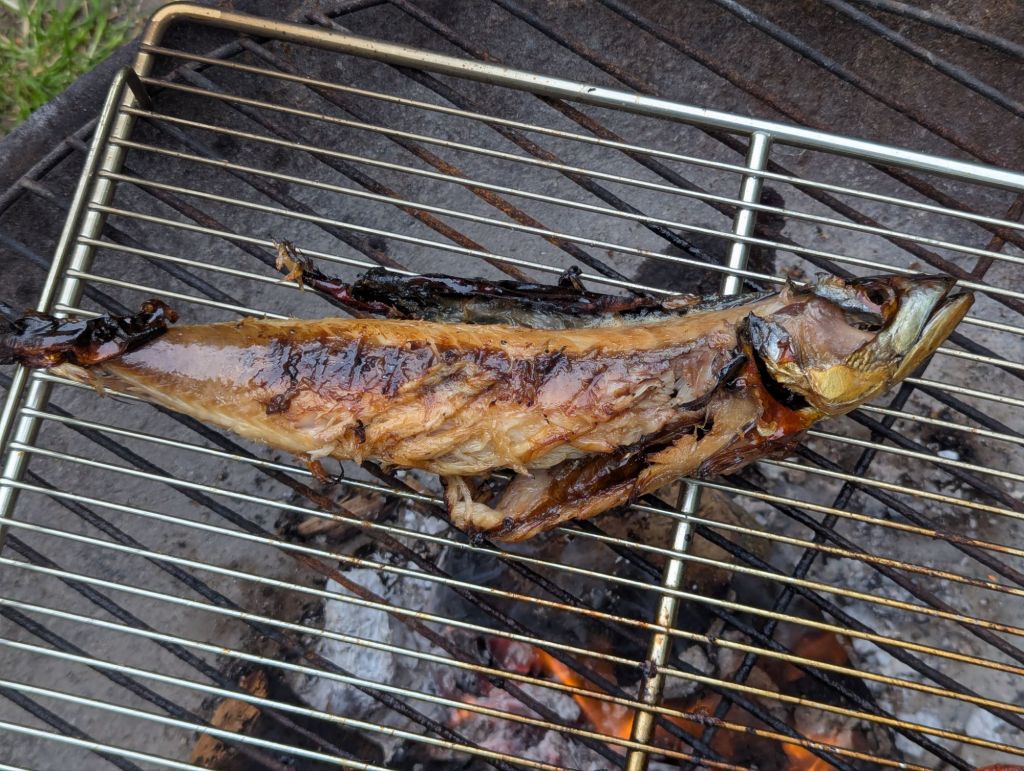
This would be my recovery shelter. I spent two nights here and made friends with a nice chap called Lars who was on a bit of a cycle tour of his own around Fyn. I even managed to do a bit of cooking on the firepit (with variable degrees of finesse and success, much to Lars’ amusement), and took a sunny afternoon to relax in the empty pool & jacuzzi of a nearby campsite. Less success on the clothes washing front though; someone had carelessly left inside a couple of wet tea towels, which had since bloomed into little mold garden.
No.5 – The shelter that wasn’t
It was quite a challenge to drag myself away from Aborg Mark, but with the weather still feeling more like summer than spring I decided to change my plan of visiting the city of Odense and instead take a ferry to the smaller island of Ærø, around 10 miles from the port of Faaborg.
Suspecting the island would be a sleepy sort of place I stocked up on gifflar cinnamon rolls along with more nutritional food at Netto before boarding the ferry for the hour long journey to Ærø.
My target destination was a free to use shelter located in woodland not far from an inland lake at the north west end of the island. It didn’t take long to cycle to the woodland edge, all I had to do was find the shelter. That’s where my plans began to slowly unravel.
All shelters on the Shelter app are marked with grid coordinates which you can open in Google Maps. I rode the bike along an increasingly overgrown forest track, ducking and diving between the branches and brambles, but the path did not lead to the shelter site – I needed to get about 50m off the path towards the lake, but it was through dense deciduous woodland.
After scanning the woods for an obvious way in I settled for the path of least resistance and began to heave and manoeuvre the fully loaded bike over the forest detritus. Movement was slow and dead wood cracked under my wheels, I just hoped the tyres would remain unpenetrated.

Eventually I ditched the bike against a tree and got myself to the exact geo location on foot – nothing. Not a shelter to be seen, or even any sign there ever was one. I don’t know if it was my GPS signal, an erroneous coordinate, or maybe the local Ærønians have installed a hidden series of webcams in the trees to amuse themselves as they watch off-islanders flounder around the dense undergrowth in search of a shelter that never was. I don’t know, but I do know it was a pain in the arse.
Fortunately I had a plan B around 8km up the road, another primitive campsite, and this one even had its own compost toilet and a tap…what luxury! The wind picked up and cloud set in with the arrival of a new weather system: it would be the last day of this miraculous heatwave that blessed the start of my tour.
Shelter No.6 – The end of the road
After escaping Ærø on a ferry to the port of Svendborg I now had two options: island hop to my way east and approach Copenhagen from the south, or make my way north and get a train across the Great Belt Bridge linking Fyn and Zealand (which is closed to cyclists). I’d had my fill of island hopping by this point, so began to cycle my way north to the city of Nyborg.
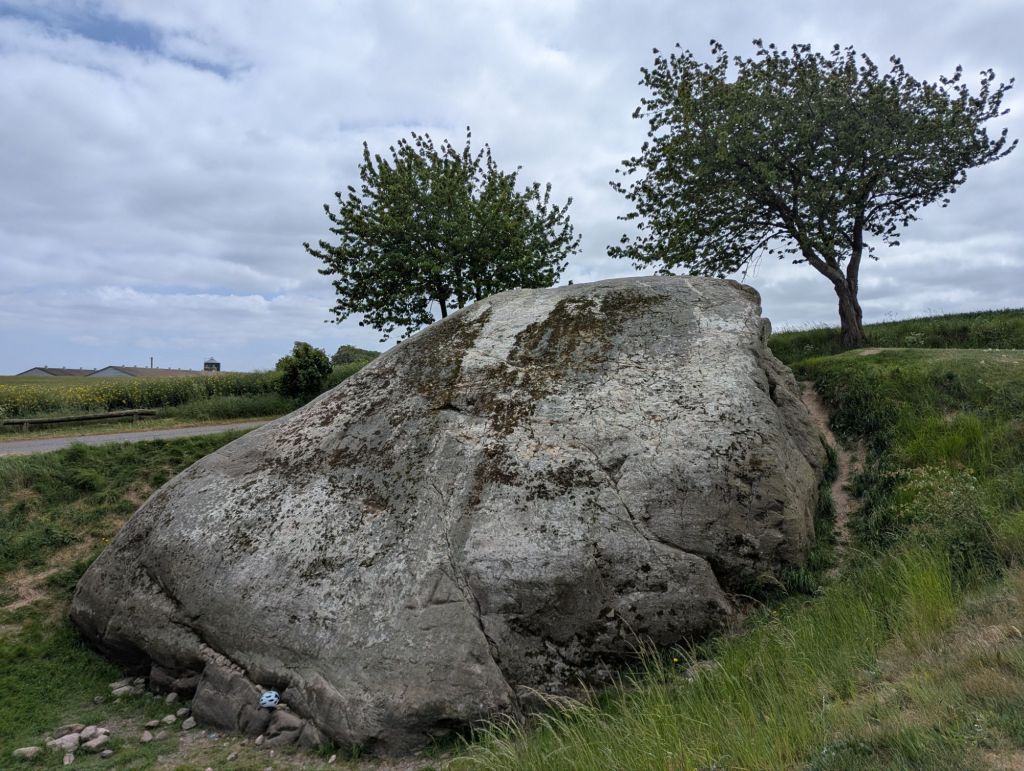
After discovering I would have to pay £20 just to see the famous Egeskov Slot (a moated castle), I set my GPS to call by the less famous Damestenen – a glacial ‘erratic’ plucked from the bedrock in Sweden and dumped by the melting ice in what is now a Danish field. In fairness the local tourist board hasn’t tried to oversell it by claiming it looks like something it doesn’t, but it is just a rock.
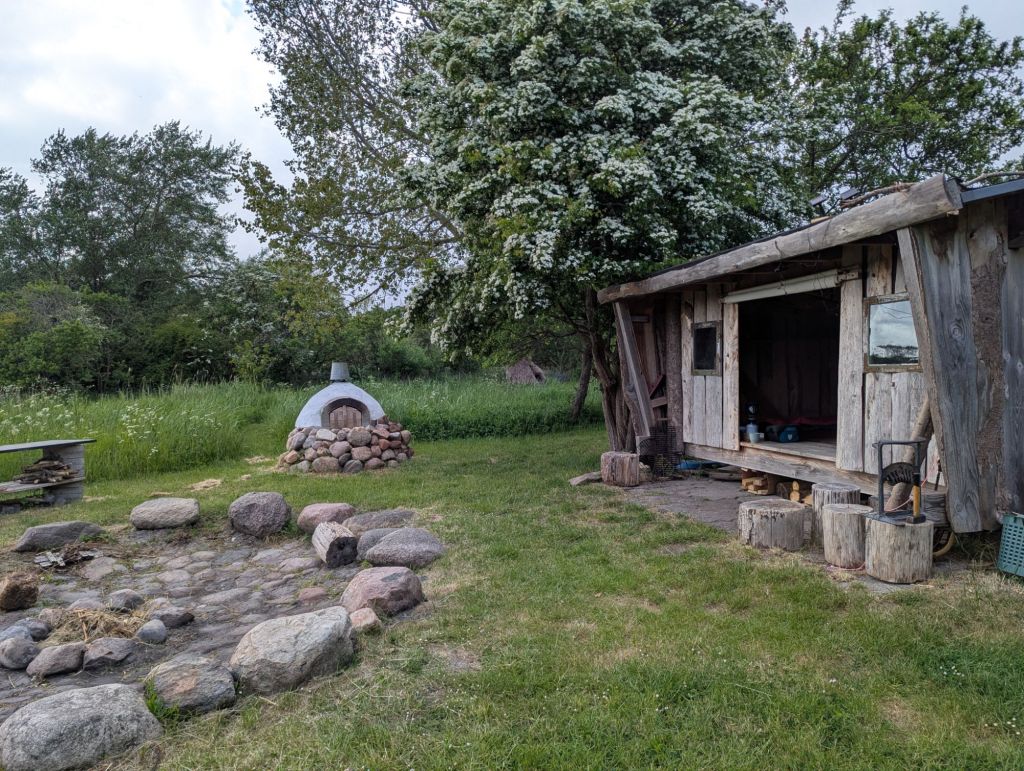
I rolled up to my final shelter on the outskirts of Nyborg, unpacked my sleeping gear and spent the evening sheltering from the wind in a different sort of construction: the local café bar. It was quite windy and the shelter, although with plentiful character and in a great spot overlooking a lake, was not exactly the most windproof. It reminded me of the 1930s wooden garage that has survived almost a century of Scottish winters beside the cottage where our family holidays up in Perthshire.
That evening I booked a train ticket for 1pm the next day. The train would not only carry me across the Great Belt Bridge, but take me all the way to Copenhagen, drawing to an end Phase 1 of my European tour. The plan was to take a bit of R&R in Copenhagen before extracting myself – and all my kit – to Norway, somehow.
————–
PHOTOGRAPHY: The Shelters of Denmark
STRAVA: rides from the 13th 21st of May


 The Cycling Brit

Leave a comment