• 4. Polder Dash: the Netherlands’ manmade and natural wonders

    There will be no shortage of royal hangovers the morning after King’s Day, but the price of beer had done a good job in limiting my own consumption and I even managed to pack up and set off in good time. The plan was to try and join my pre-planned route in Flevoland, but to do this I would need to cross the body of water that separates Holland from the north-eastern Dutch provinces.

    Provinces of the Netherlands
    (credit: Wikipedia)

    I assumed this body of water was a large tidal bay crossed by a couple of impressively long road bridges. But the Dutch being Dutch, these roads are not bridges but dams: they form part of the Zuiderzee Works that have totally transformed this landscape over the 20th century. My crude understanding is the dam provides a barrier to protect the area from flooding by the North Sea, whilst also turning the bay into a freshwater lake that can be drained at low tide. This ability to drain water logged areas has given birth to significant areas of brand new land – so called ‘Polders’ – one of which is Flevoland where I was heading.

    The continued sunny weather brought the locals out to enjoy their favourite Sunday morning waterside activities along the winding cycle path that followed the shore of the Markermeer lake, which was now glistening in the midday sun. Odd to think that if the proposed Markerwaard polder had been built and the lake was fully reclaimed as originally planned, there would have been no waterside left for these people to enjoy. As it happens, the NIMBYs of Hoorn are a formidable bunch and the battle was won to protect their waterside amenities – the idea was scrapped in 2003 after a century in the planning system. Typically a sea view offers reliable protection against development encroaching your backyard…not in the Netherlands!

    Upon arrival at the entrance to the dam that splits the Markermeer and IJsselmeer I snook into a museum toilet to top up my water and caked myself in factor 50 suncream, there would be virtually no shade for the next 26km so the protection was needed. Except it wasn’t the sun that was about to subject me to torture but hoardes of midges, strung out in long black clouds along the waterside cycle path. My sunglasses protected from direct eyeballs strikes, but they seemed to ricochet their way in through the open sides. The hair on my arms and legs quickly became saturated with the corpses of fallen flies, which had either exploded on impact or dissolved in the toxic mass of hair, suncream and crystallised sweat salt.

    I tried ducking my head, weaving, and even swearing at them but it was futile, I needed a better strategy.  Not long after joining the cycle path I passed a man with a road bike who had stopped for a toilet break (no. 1); after battling through several kilometres of midge clouds the man caught up with me and overtook on the left hand side. This was my chance. I stamped on the pedals and managed to tuck in close behind the bigger man, whose large silhouette not only sheltered me from the plague of flies but also the mild-yet-irritating headwind that blew across the lake. The man glanced around to inspect the source of heavy breathing that was now following him – a sunbaked Brit covered in dead flies hauling a 46kg quite un-aerodynamic bicycle – and mercifully continued his 28km/h tempo which I could just about hold onto for a good chunk of the dam.

    Eventually the flat road briefly ramped up to a small gradient as we crossed a channel and my human shield pedalled away towards the horizon. Thankfully the flies had now largely dispersed, but there is still something quite soul destroying about cycling along a very long, straight, flat road – the scenery becomes static and unchanging, with only the occasional seabird breaking the monotony. People complain about riding up hills on bicycles, but at least your legs get a rest on the descent, endlessly flat roads can feel relentless – and there would be plenty more in this part of Europe.
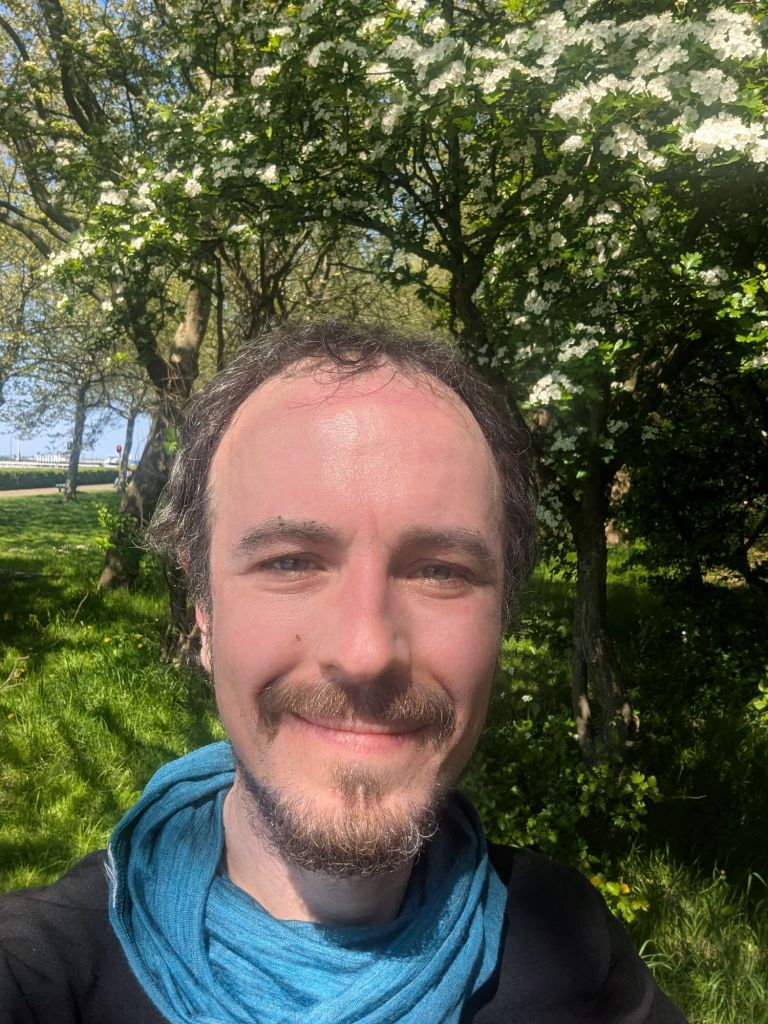
    Victory – look carefully at my right eyebrow and you will see the bodies of several midges lost in the Great Houtribdijk Massacre

    Don’t tread on the tulips

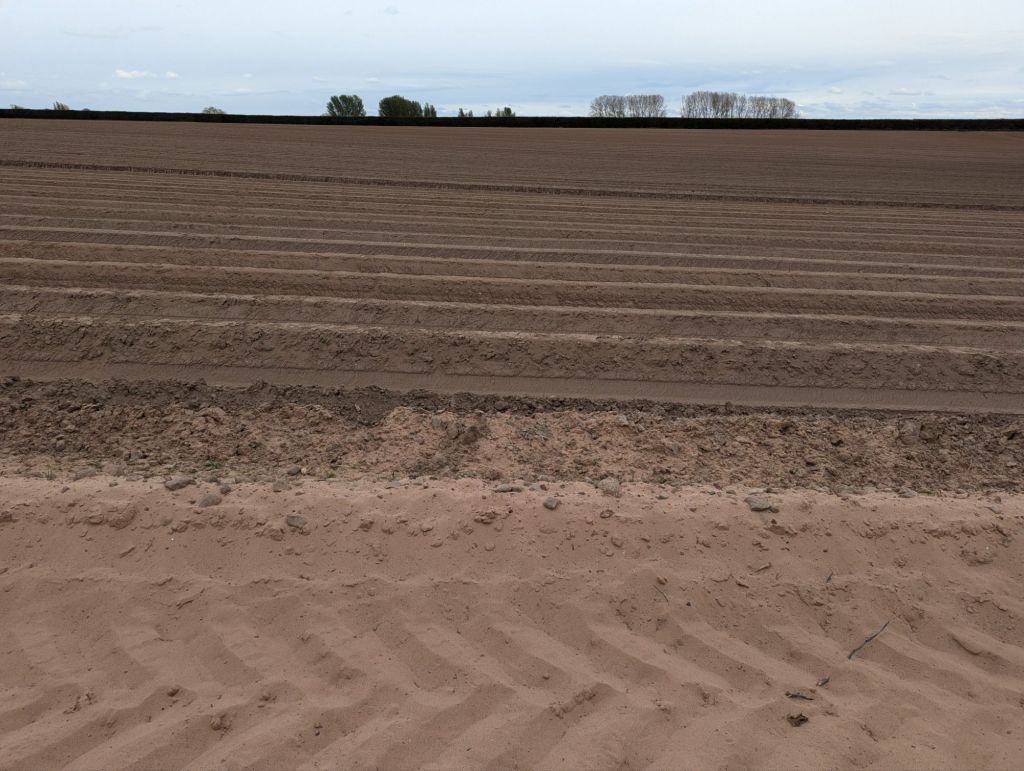
    The thing about a dijk is they are necessarily quite tall structures, so I didn’t see much of Flevoland at first after joining the polder along the long straight road that runs along the lakeside. Upon crossing the Ketelbrug bridge I was finally on more conventional roads again, heading into the heart of (the slightly mushroom-shaped) Noordoostpolder.

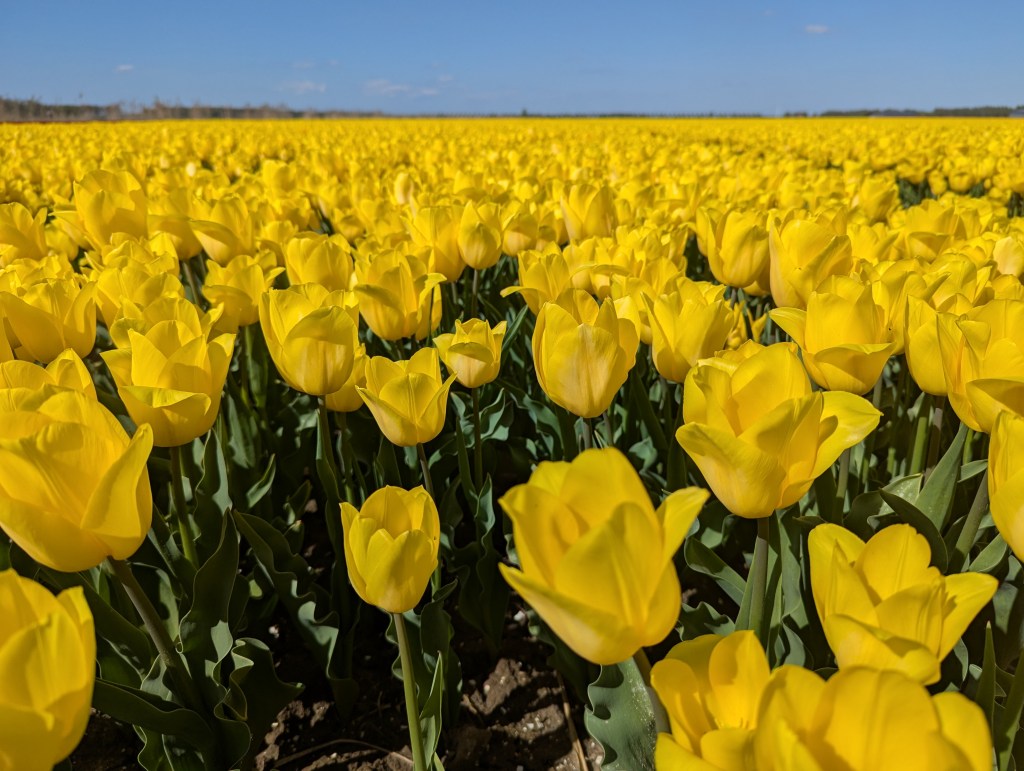
    The odd field of tulips had appeared on previous days but these were under more overcast conditions. The fields beside me were suddenly beaming with saturated hues of red, yellow and white, like unmixed oil paint squeezed straight from the tube. By pure chance I had arrived more or less in peak tulip season. If you’re wondering what they do with millions of tulips upon harvest in late spring – although they may sell a few flowers they are mainly after the bulb. The flower head is removed and the plant diverts growth to the bulb instead, which is then dug up a few weeks later for sale or replanting.

    Most tulips have their own moat to keep invaders at bay

    The majority of tulip fields are protected from the public by an encircling ditch, but these particular fields – located along the signposted ‘tulpen route’ – had a small access bridge allowing for closer inspection. The farmer’s children were on duty to keep the tourists in check and bark instructions at those getting a little too close, led by the eldest boy who seemed to relish in this minor delegation of authority; I was sympathetic to the cause, but there was a mildly irritating style of execution, and I did wonder how easy it might be to pick up the little bureaucrat and hurl him into the nearby drainage channel (…don’t scrunch up your face, we’ve all met annoying kids before). But I was here to ride a bicycle not assault the local children, so onwards I went.

    It may look like I crossed into the demilitarised zone between tulips and plebs, but I was using the magic of camera zoom, honest!

    Into more natural surroundings

    I took a brief pit stop at the edge of a car park in the uninspiring town of Emmeloord to ponder where I would stay for the night. After a toss up between a pricey hostel and rustic campsite I opted for the better value camping option, located in the National Park Weerribben-Wieden.

    The natural habitat of this region is of course wetlands. The expansive, hedge-less agricultural fields were slowly replaced by water logged bogs, with many more woodland areas appearing along the roadside. After a few navigation blunders I found myself in the picture-postcard village of Kalenburg, with its idyllic modern looking houses lined up along the banks of a canal. Locals and tourists slowly chugged along in their pleasure boats, sipping wine in the evening sun and offering the occasional friendly wave, with some younger residents playing a game of ‘jump into the rubber dinghy’.

    The campsite was small but picturesque, occupied by only a few couples (and their dogs) in motor homes. The owner was nowhere to be seen, so I picked a spot and got setup for the evening. I knew the site would be rustic but I did find the lack of showers to be a bit annoying given my sweaty condition after 116km of pedalling in the sun. The solution was obvious, change into the pair of orange swimming shorts (with saguaro cactus motif) I had brought and cool off in the canal, which had an access ladder leading right onto the campsite grounds. As you probably guessed, the water was excruciatingly cold, so I took a moment to compose myself whilst grasping onto the ladder until the cold shock response fizzled out, then had the briefest of swims and extracted myself back onto dry land. It wasn’t until my evening after-dinner walk that I discovered the shower block, equipped with hot water on the opposite side of the reception building.
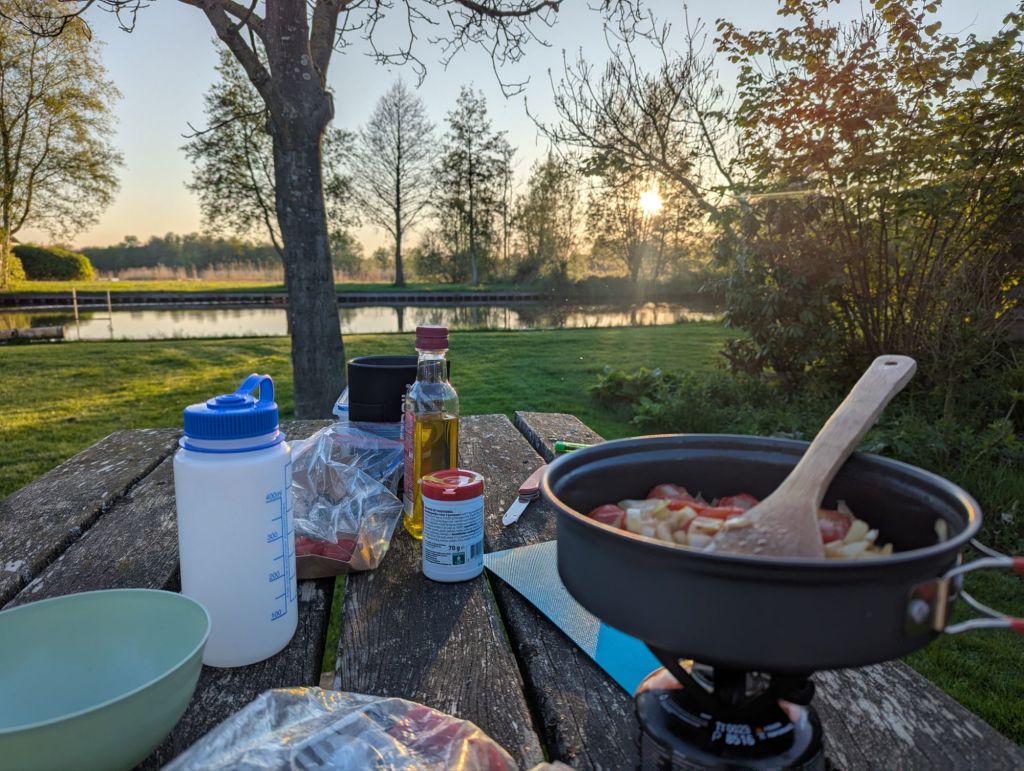
    The dining experience when camping is greatly enhanced by a bench, even a slightly scabby one

    I would normally have been ready for a lie down after a long day in the saddle and late dinner, but I was struck by the chorus of peculiar sounds emanating from all around me, growing louder as the sun retreated. There seemed to be more bird life in this national park than all the other regions I had passed through put together, in particular ducks and geese; there would barely be a second pass without a honk, shriek or caww ring out. The amphibians joined in too – I can’t tell you if they were frogs or toads because I didn’t see a single one, but I was a trapped audience in the relentless symphony of croaking.
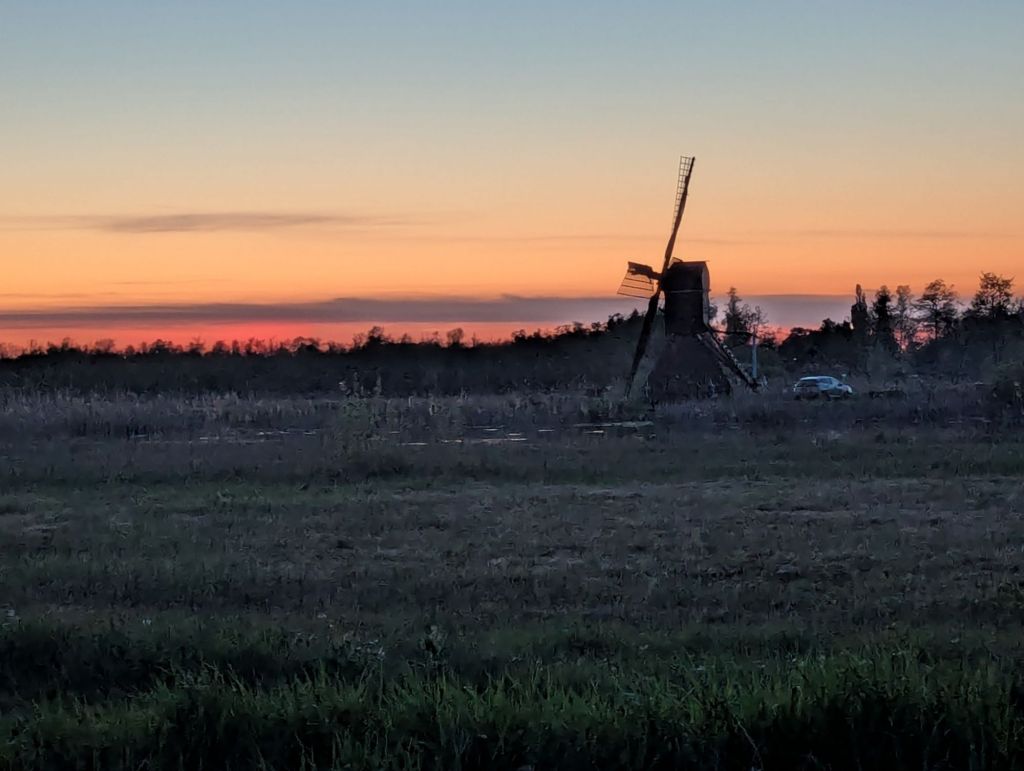
    Dusk in the Weerribben-Wieden

    The windmill

    There’s no escaping them, the Dutch landscape is scattered with windmills. Well, not exactly: the majority nowadays are the familiar white turbines that generate electricity, but there are still plenty of old fashioned ones around that either mill grain or pump water, and they can be quite stunning.

    So when I cycled beside an ‘open’ sign pointing towards a textbook example, and time on my hands, I parked up the bike and headed in.
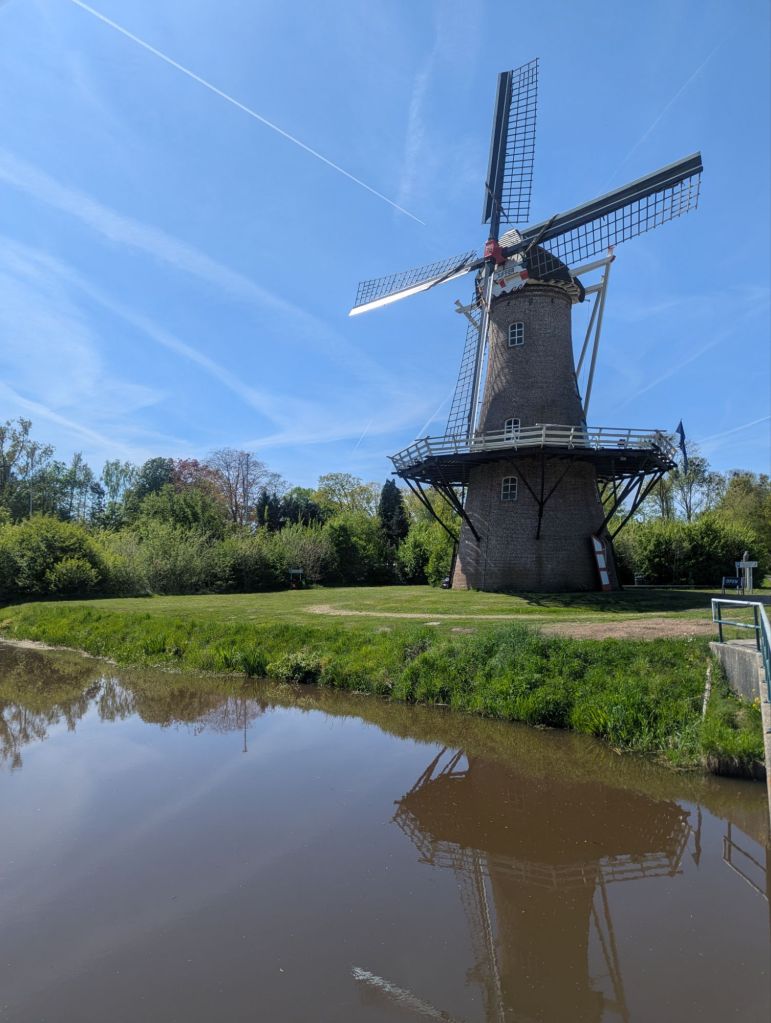
    Spot my bicycle for ‘Where’s Wally?’ points

    A Dutch ‘prijslijst’ of bready sounding products stapled onto the front door made me question whether it had been converted into a bakery, but it was soon clear the building had been restored into a living museum for public consumption. After climbing the steep stairs to level one I was met by a weather-beaten Dutchman of around 65 years, who had the rare distinction of speaking no English whatsoever, which as a fellow mono-linguist I respect greatly. He called up to his co-worker, a softly-spoken man of similar vintage with a short white beard, who climbed down a ladder from the second floor and I was treated to a personal tour of the mill. After talking through the history and inner workings, we headed out onto the sun-drenched balcony to release the brake – after a gentle nudge from his colleague the sails began to turn in the light breeze and the mill suddenly came to life.
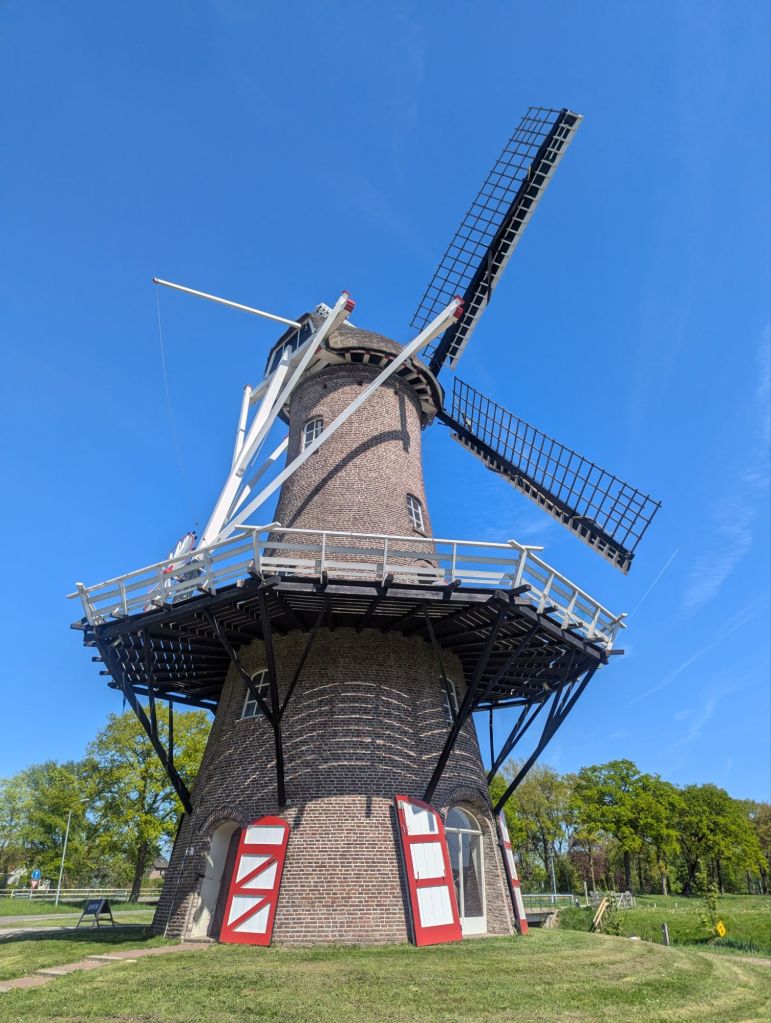
    The brake cable is attached to that big wooden arm sticking out behind the sails

    A bit like when steam railways still provide passenger services on heritage lines operated by keen volunteers, the windmill was being put to work by grinding grain, mainly for animal feed these days. What was nice about the experience was not so much the windmill but the two chaps operating it – they understood every little piece of that mill and how to maintain it, which follows a design changed very little since the 1600s. It is easy to see how practical knowledge can be lost when people like this weld their last rivet or mill their final grain of wheat without an apprentice to keep it all going for the next generation.

    Pottering around inside a windmill felt like a fitting end to the Netherlands, but the time had come to move on and head for the border. Next up, Germany – a country that had barely registered in my mind when planning the trip.
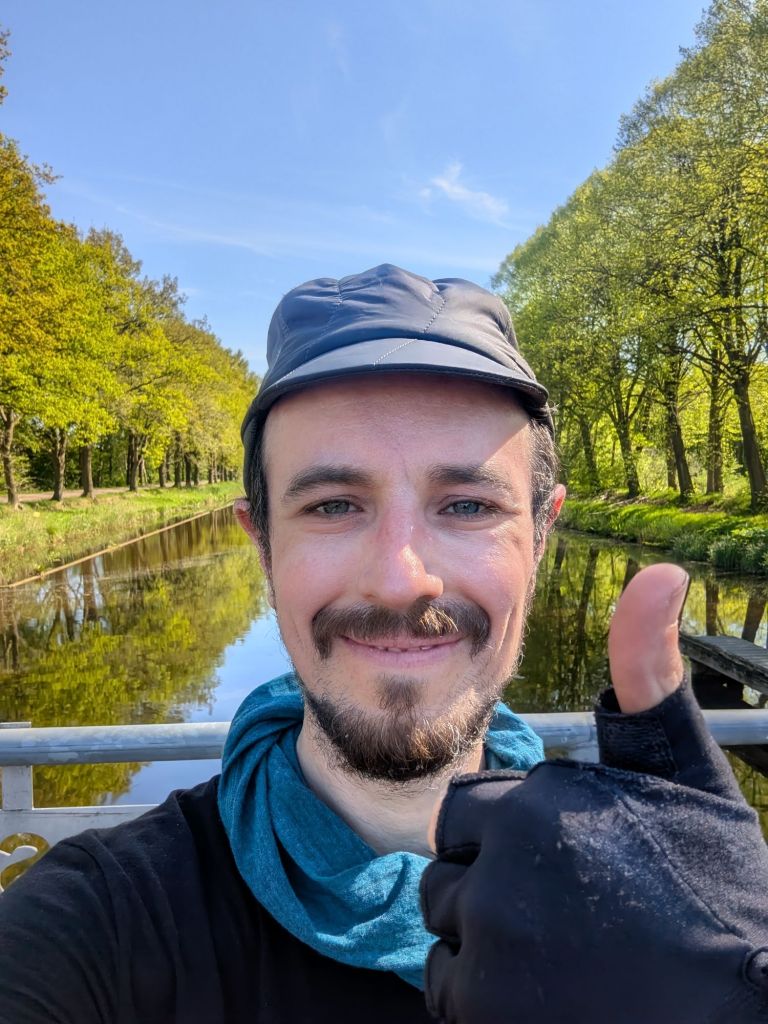
    A happy Brit – but would Germany wipe away that smile?

    PHOTOGRAPHY: Flevoland & north east Netherlands
    STRAVA: rides between 27th and 30th of April

  • 3. Oranje Fever – a soft landing in the Netherlands

    My arrival at the family home was the perfect opportunity to revisit the contents of my panniers and offload the more ridiculous objects that I had dragged to the top of those steep Peak District climbs. So amongst other things, it was goodbye to the smart shoes, suit jacket and choral sheet music.

    After flicking through the ferry prices from Newcastle to Amsterdam I was disappointed to find no real bargain-basement option, like where you simply sit in a chair for the duration rather than get a bunk. The most cost effective option DFDS offer solo travellers is a private twin cabin, so I skimmed through prices on different days of the week and found the cheapest was Wednesday – perhaps a little early for most stag and hen dos.

    After a ‘last supper’ at the local Italian restaurant on a quiet post-bank holiday Tuesday evening, I re-packed the panniers with their now slightly leaner contents in preparation for the morning departure. My family seem satisfied I haven’t gone completely insane in stepping away from a sensible career to embark on such an endeavour, but probably wonder why anyone would voluntarily expose their arse to months in a bicycle saddle? After collecting an envelope of Euros from Ramsdens the final task on my list was ticked off; I stepped onto my (noticeably lighter) bike, said my goodbyes to the family and got the northbound local train from Billingham towards Newcastle.

    The sun setting on Billingham town centre

    I wanted to get off at Heworth on the south bank of the river Tyne, so I purchased a train ticket to further away Newcastle to save money (yes you read that correctly, our perverse train ticketing system is a nothing short of an incomprehensible mess at this point). Once off the train I began to cycle my way towards the ferry terminal, dodging endless fragments of broken bottles and dog shit strewn across the cycle paths. Not the most glamorous route perhaps, but it did include a tunnel under the river. You can even ride your bike along the dedicated cycling lane in the tunnel, which is quite a fun activity whilst you run catastrophic failure scenarios through your mind – if the whole thing suddenly collapsed and the Tyne started pouring in, would the water rush in from one end like a raging tsunami? Or would it be more of an implosion from every direction? It’s not a phobia, just morbid curiosity I think Dr. Anyway it was a very nice tunnel with colourful lights and mercifully no river water in sight.

    The Tyne-Tunnel’s technicolour elevator to Howdon

    After a short queue at the ferry terminal I boarded the ship’s hull and was directed to the bicycle storage area, where a crew member insisted I could not lock the bike (either to the railing or to itself) for our reasons of our good friend ‘health and safety’. I asked if the cars and lorries were also left unlocked for this reason, and it soon transpired that the underlying reason was nuisance caused by passengers abandoning locks (or entire bicycles) which then need to be angle grinded off. I satisfied myself that the risk of theft was genuinely minimal, then for the first time ever attempted to carry all six of my panniers & bags in one go: awkward, but doable!

    Farewell Brittania – the attractive Herd Groyne Lighthouse at Tynemouth

    The ferry is marketed as ‘Newcastle to Amsterdam’ but actually sails from North Shields to IJmuiden. The double capitalised ‘IJ’ confused me at first, until Wikipedia told me it is a digraph, which confused me further, so feel free to look it up for yourself, but I reckon it would probably be spelled Aimoden if it was a British town.

    After a gentle overnight crossing accompanied by a few pints of Guinness in the sparsely attended bar on deck 8, I emptied my pockets of soon to be useless sterling coins in exchange for an overpriced breakfast, peering out the window whilst our Dutch pilot manoeuvred the vessel through a worryingly tight gap between the river bank and a small (but heavily fortified) island.

    Fort IJmuiden, like Fort Boyard but with less Melinda Messenger

    The call for deck 4 screeched out across the ship’s PA system and I made my way to the cycle storage area where I was greeted by a handful of fellow cycle tourists loading up their bikes. After 10 minutes or so a crew member gave us the knod and we marched our bikes along a narrow gap between the rugged grooves of the ship’s steel floor until on dry land, then cycled the last 200m up to border control.

    “Passport please”, delivered from the usual stone like stare of a border force officer. “Where are you heading?”

    For some reason it had never occurred to me that I might actually be asked this basic question upon entry, I had been more concerned about the Schengen 90/180 rule upon re-entry and not getting tangled up in visa applications.

    “I’m heading to Denmark” blurted my instinctive  response, which is where I will cycle before getting another ferry to Norway. I didn’t want to get into the full convoluted plan, and he didn’t want to hear it, so he handed me my passport, wished me well on my trip and opened the gate. I was in Holland and Europe was my oyster.

    The Cycling Brit’s abroad – kudos to the woman cycling in a fedora

    Every journey starts with a first step

    After a careful exit from the busy port I found myself on the south bank of the north sea canal which runs through the centre of Amsterdam, around 35km to the east. Amsterdam is a great city and all, but I’ve been several times before and was not really in the mood to ride through such a busy urban area just yet, so I headed for what looked like a bridge on the map.

    Navigation

    A quick word on navigation: I have planned a route up to Scandinavia, down to Istanbul, and back through the Balkans and southern Europe. I will not necessarily always stick to the route – and I don’t currently have a route planned for east of Istanbul – but when I am on a route I can simply follow the GPS computer which will show me the way to go. Without a pre-planned route you are left to either follow your nose or rely on a map of some sort, Google Maps in my case. So when I say ‘the map’ I mean the map on my phone (rather than fighting with a badly folded 1:50,000 OS Landranger).

    As I pedalled further east along the heavily industrialised canal side there was a distinct lack of any form of bridge to cross. Upon closer inspection the bridge I was seeking was in fact a tunnel for the A22 dual carriageway – which to cycle through would be a trifecta of horrid, dangerous and illegal – but this being the Netherlands there was obviously a cycling friendly solution: a free ferry across the canal. I hopped on board alongside a small vehicle for sweeping street gutters and a couple of french cyclists touring with their border collie in tow (a piece of kit that didn’t make it onto the spreadsheet, not this time anyway).

    At this point it began to rain, so I largely abandoned the map and headed north following the cycle paths which complement pretty much every road above a certain size in the Netherlands. The Dutch have cycling tunnels buried under main roads, roundabouts where vehicles have to give way, and the vast majority of paths are in great condition even those in the middle of forests and crop fields. I promise I will stop gushing over Dutch cycling infrastructure, but it really is world class and helped to soften my landing on this trip in so many ways, especially whilst I reprogrammed my brain to ride on the opposite side of the road.

    After passing through a few smaller towns I arrived in the city of Alkmaar, famous for its cheese market. Well, not quite famous enough for me to have heard of said cheese market, but maybe I’m just out of the cheese market scene at this point in my life. I did once attend Tavistock cheese market in Devon with a friend who had worked in the local cheesemonger – I’m a complete lightweight when it comes to cheese, strong cheddar I can handle, but when it starts to smell of feet I struggle. In Tavistock I went for the ‘exposure therapy’ tactic and forced down samples of cheese on offer from every single market stall, hoping I would suddenly see the light and walk out a lover of stilton and Shropshire blue: I did not.

    Soggy plums on the streets of Alkmaar

    I paced up and down the facade of a Jumbo supermarket wondering where to lock my bike and which panniers to remove. A kind woman passing by noticed my conundrum and pointed towards a narrow alley marked by a yellow wooden archway and bicycle sculpture. It was a dedicated bicycle parking lot manned by an attendant, which although a little pricey at €5 was the perfect stress relieving solution in that moment.

    Before heading down the alleyway to park up to stock up on groceries, I caught the eye of a local chap of around 70 years age wearing a white nautical hat. He was excited to learn I was from the UK and curious about my about my trip. He soon established that I had absolutely no idea the country was set to celebrate Koningsdag (King’s Day) on Saturday, which by his description was quite a big deal in the Netherlands, where people take over the streets with flea markets, play music and have a drink (or ten). He recommended I get away from the rowdy and sometimes turning violent celebrations in Alkmaar and head east to the more relaxed town of Hoorn, which is exactly what I did.

    Alkmaar to Hoorn is quite a straight forward journey but in this instance mhampered by headwinds. I checked into Camping’t Venhop on the city outskirts, a campsite that resides in the armpit of a section of the A7 dual carriageway; not the quietest spot, but the bogs were clean and I had full use of my very own picnic bench right beside the tent, always useful for those travelling without a chair. I tried a special technique to pitch my tent in the rain without drenching the inside, which although a bit awkward was quite effective, then reached for a can of tuna with no ring pull.

    “Not to worry” I hushed to myself in an effort to stave off the urge to throw the can into the nearby canal, “I’ve definitely seen a YouTube video on this”. I reached for the old fashioned tin opener on my Swiss army knife and tried to recall each step of that video. Let’s just say I will be revisiting my technique in the future.

    Jagged metal, jagged metal…tasty fish!

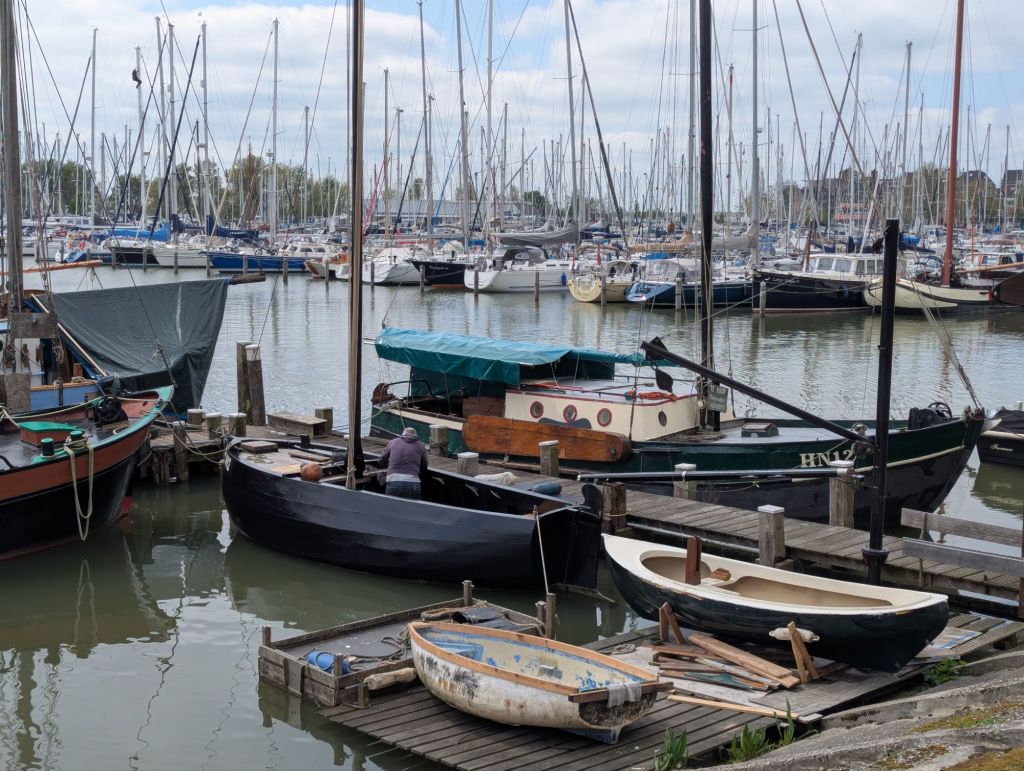
    After a damp first day in Holland the rain clouds passed and the sun had begun to shine in Hoorn on Friday morning, so I seized the opportunity to leave the campsite and explore the town and pick up a few items. Hoorn was home to the chap who first sailed from Europe to the Pacific Ocean around Cape Horn at the southern tip of South America, and this proud maritime heritage is quite clear. The Dutch love a good boat and there is no shortage of them around Hoorn, including some beautifully carved wooden specimens.

    A local Hoornaar at the boat maintenance dock

    One thing you notice about the Netherlands is how precariously close to the waters edge their houses are often built, with much of the waterways subject to some degree of manmade control to avoid flooding. The Dutch have been manipulating this naturally water logged landscape for centuries and exporting their skills to similarly wet places ever since.

    Terraced houses along the Turhaven canal, Hoorn

    After a relaxed day pottering around Hoorn’s canals and small side streets I retired to Camping’t Venhop for a meal and evening walk around the campsite. A large area was dedicated to static caravans, where the size, shape and general condition of each caravan seemed to vary considerably from one plot to the next. I could feel a mild plume of envy rise inside of me as I peered into the window a well-lit living room with cosy soft furnishings and remembered how I hadn’t even brought a chair, “smug gits”.

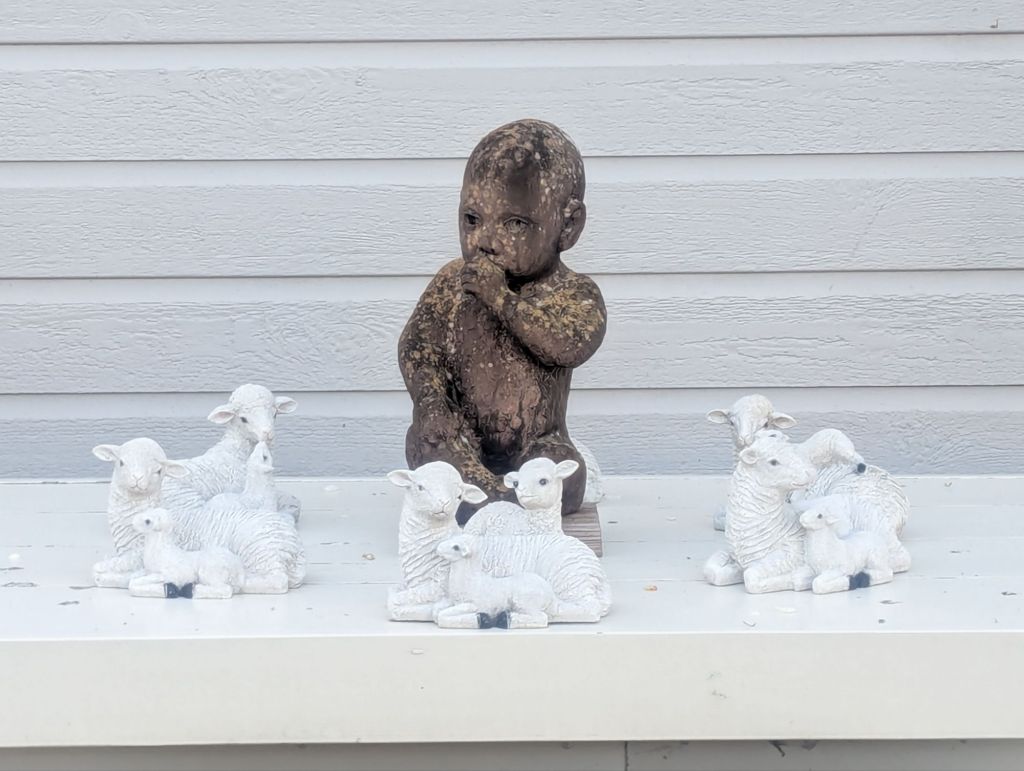
    Springtime garden ornamentation, Camping’t Venhop style

    50 Shades of Orange: Koningsdag

    If the friendly man I had met on the street in Alkmaar had not explained to me about the upcoming King’s Day I would have spent Saturday morning packing up my tent and pressing on with the cycle tour. Instead, I lathered myself in suncream and headed into Hoorn for what according to the Google Translated regional news was to be the first warm & sunny Koningsdag for many years (if you forget about 2020, which most are happy to do so).

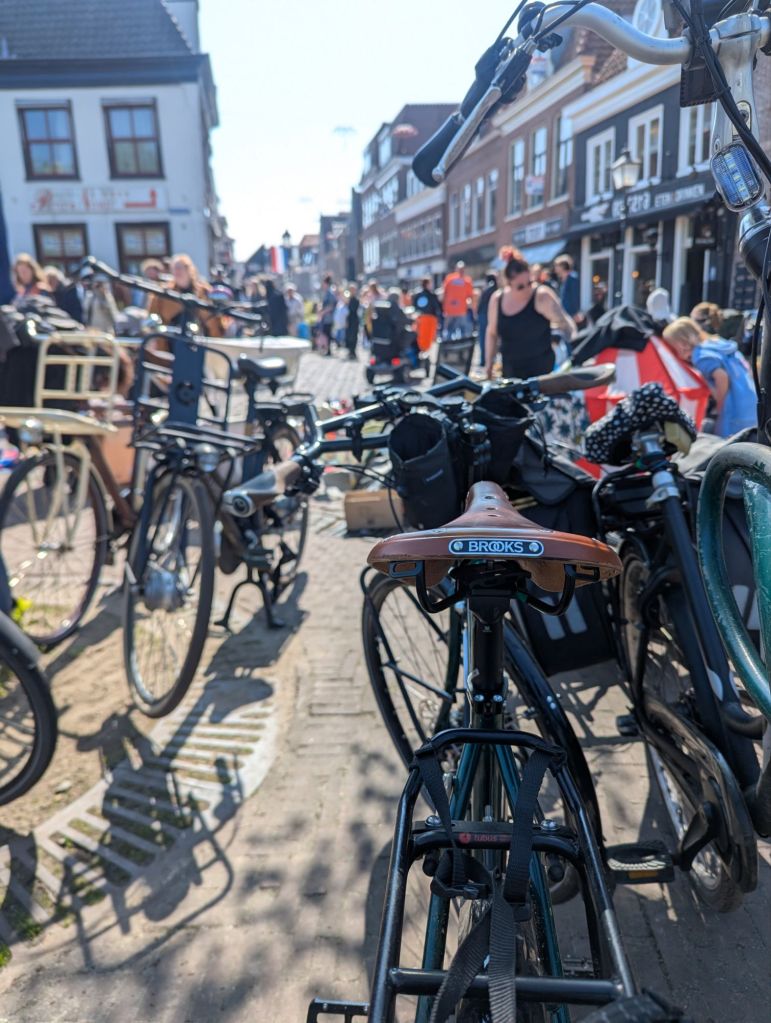
    The Brooks taking shelter in the shade

    As I cycled towards the centre I pondered where I might lock up the bike whilst I enjoy the festivities. A recurring problem I had encountered was the surprising lack of ‘railing style’ racks where the bike can be leaned against the railing and you lock your frame to it. The majority of Dutch bicycles come equipped with a heavy duty kick stand which allows you to roll up to your destination of choice, engage the kick stand, and lock the bicycle to itself (often with an integrated lock built around the back wheel), all without any need to hunt down a bicycle stand. When you do find a bike rack they tend to have a slot for your front wheel to slide into, which is great if you don’t have a front rack, so for me to use them usually required a bodge where I either leaned up against the end of a rack or hogged two spaces, sorry folks!

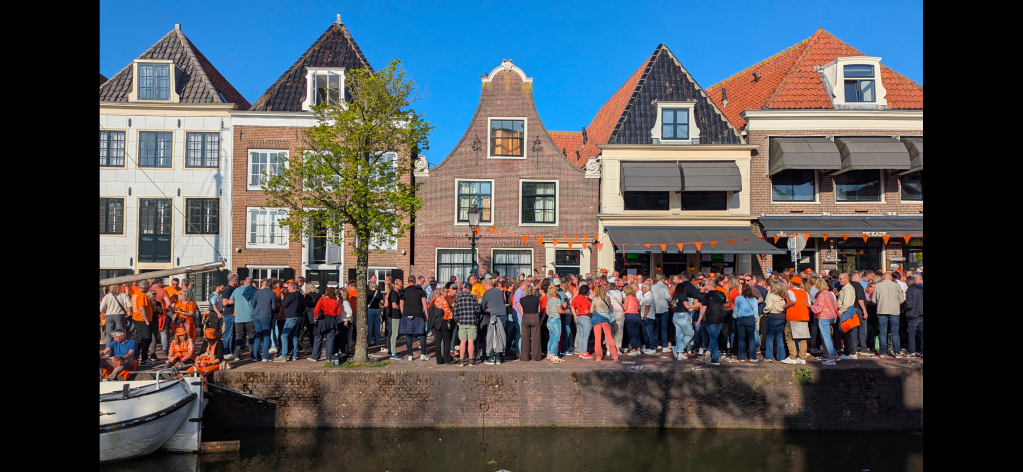
    There are three main themes to King’s Day in the Netherlands: flea markets, drinking, and orange.

    White elephants – this chap’s best seller seemed to be a bunch of vintage Dutch Tarzan posters

    At the flea markets, ordinary folk can throw down a tarp onto the street, lay out the various items that have been cluttering their house since the last King’s Day for sale, and command their tween children to stand there and deal with the punters whilst the parents kick back and drink beer in the shade – no permits required or VAT applicable, basically one big jumble sale in the street. From what I saw the best sellers were women’s and children’s clothing, but there was quite a variety of offerings, including those trying to make a quick buck with quite obviously bulk-bought new items, especially unopened packets of Pokémon cards.

    Drinks flowing at Roode Steen square

    In Hoorn, the drinking centres around several areas, each with a PA system and space for mingling, dancing, singing, and conga lines at its nucleus. I paid €3.50 for a 250ml plastic cup of ‘bier’ (plus €1 cup deposit), which would have been a bit pricey if the beer was good, but a down right rip off when you are paying equivalent to c.£7 a pint for what tasted like the shittest lager in Holland. No wonder the security chap checked my bag for smuggled alcohol.

    Regal energy: the Queen of Orange with her subjects

    The colour orange is inescapable. Bright orange , dark orange, neon orange, pastel orange. Orange clothes, orange jewelry, orange balloons, orange face paint, orange novelty crown hats – you name it, they will orangify it. Anything decorated with the Dutch flag is augmented by an extra stripe of orange to make up for the flag’s curious lack of this national colour.

    It had been a fun day, but I decided to pass on partying into the small hours to avoid feeling like crap on my planned morning departure. Although not before a brief dance with the Queen of Orange herself – nope not Beatrix, she abdicated in 2013 – but a woman who held the distinguished title of the most orange person at Hoorn King’s Day 2025. We made a good duo as the only orange on my being was a few accents on my shoes, with shoes her only non-orange garment in sight.

    Now it really was time for bed. The plan was to leave Holland in the morning and venture into the Netherland’s lesser known provinces.

    PHOTOGRAPHY: Ferry & North Holland

    STRAVA: Day 1, Day 2, Day 3

  • 2. Testing the waters – a mini tour on home turf

    What happens with big plans like cycling tours is they evolve over time. There may be several iterations from the original day dream over a Sunday morning cappuccino, through to the final plan that is eventually implemented.

    My original plan for this trip was to meander my way from my adopted home of Shrewsbury down through the midlands, home counties, London(!), and Kent before arriving at Dover for the short hop by ferry across the channel to Calais. Once on mainland European soil I would head north east into Belgium and enter the Netherlands from its southern most province of Zeeland. However, when discussing these plans with various friends and colleagues I received several puzzled expressions as to why my plan was not to take the ferry from Newcastle to Amsterdam…this would reduce the distance to Norway (my first key destination) and allow for a detour to the family home in Teesside.

    So the plan was changed – after handing in the keys to my flat I would load up the bike and cycle my way from Shrewsbury to Newcastle ferry terminal, with a pit stop at home to disburden my panniers of their more bizarre extra baggage and refine the setup before setting off to Europe. I suspect this will not be the first change of plan on my journey.

    Day 1 – Escape from the Shire

    Picking up from my last blog post, with every pannier and luggage bag approaching the point of bursting, I officially set off from Shrewsbury town centre at around 16:45 on the 14th of April. Unless you’re a fan of stopping just as you’re getting started, putting up tents in the dark, or gnashing your teeth and riding on through the night, I would not recommend 16:45 as a departure time on a normal day’s cycle touring.

    So with time against me and darkness encroaching I wrestled control of the bike’s antler-esque handlebars and headed east for the delightfully named village of Upton Magna around 10km away.

    Undeniably my first impression was how immensely heavy the bike was compared to anything I have ridden before. I don’t know how it compares to other touring bike setups (I’ve  seen some real juggernauts in YouTube videos), but for me it was heavy. However, although the acceleration is slow, once you reach cruising speed the bike has so much momentum it seems to almost launch itself up the road’s smaller rises and undulations.

    The more worrisome handling quirk was a peculiar oscillation in the handlebars. The sensation was similar to the dreaded ‘speed wobble’, where the bike (either pedal or motorbike) begins to leer from side-to-side at a resonant frequency, which if not corrected can eventually eject the unlucky rider from the comfort of their seat. But this wobble was occurring at lower speeds. I assumed it was down to too much weight in the handlebar bag and carried on.

    Slow acceleration and wobbles put to one side, I was pretty satisfied with the bike and how it handled the weight. It can be a bit daunting when you first climb onto a fully loaded tourer, but as with most skills, with time it becomes second nature.

    The road network of north Shropshire has several smaller lanes where the tarmac gives way to more of a dirt road or gravel track. I don’t know if it was down to the unusually dry start to the year we’d had, but I managed to include a road on my route that morphed from gravel into pure sand. I can now confirm it is possible to pedal a fully loaded tourer through deep sand, but I do not recommend it at high speeds, mainly due to the front wheel having a mind of its own. I cut my losses, got off and pushed…I had already succumbed to pushing the damn thing (known as ‘hike-a-bike’ in the lingo) and I hadn’t even got out of Shropshire. I will need to up my game when it comes to the dirt roads of southern Europe.

    The pastoral sand dunes of North Shropshire

    With the light now fading and unwelcome arrival of rain, I fumbled my way around Google Maps and found a campsite near the Staffordshire border, around one hour’s cycle away. I arrived in darkness to signs suggesting the presence of a campsite but no obvious entrance or reception. It turns out this particular campsite falls into the category of “farmer’s revenue diversification”, aka a small field with the grass kept low, a single bog, shower, and a basin for washing pots – no frills. It also happened to sit adjacent to the west coast mainline railway line, frequented by both passenger and freight trains at a good 100mph+.

    Though basic, the campsite was fine for my needs, so I got to work on pitching my MSR Hubba Hubba NX 2-person tent outside for the first time (I did once put it up without pegs in the living room). At the time I would have paid good money to anyone with deity like powers to stop the rain from falling at that moment, and perhaps even bring back a few rays of sunlight, but sometimes a baptism of fire can strengthen the constitution, or at least set a bloody low baseline for your future camping endeavours. The inner tent got frustratingly wet during construction, a situation not helped by my immediate breaking of the cardinal rule by getting inside with my (soggy grass covered) cycling shoes on.

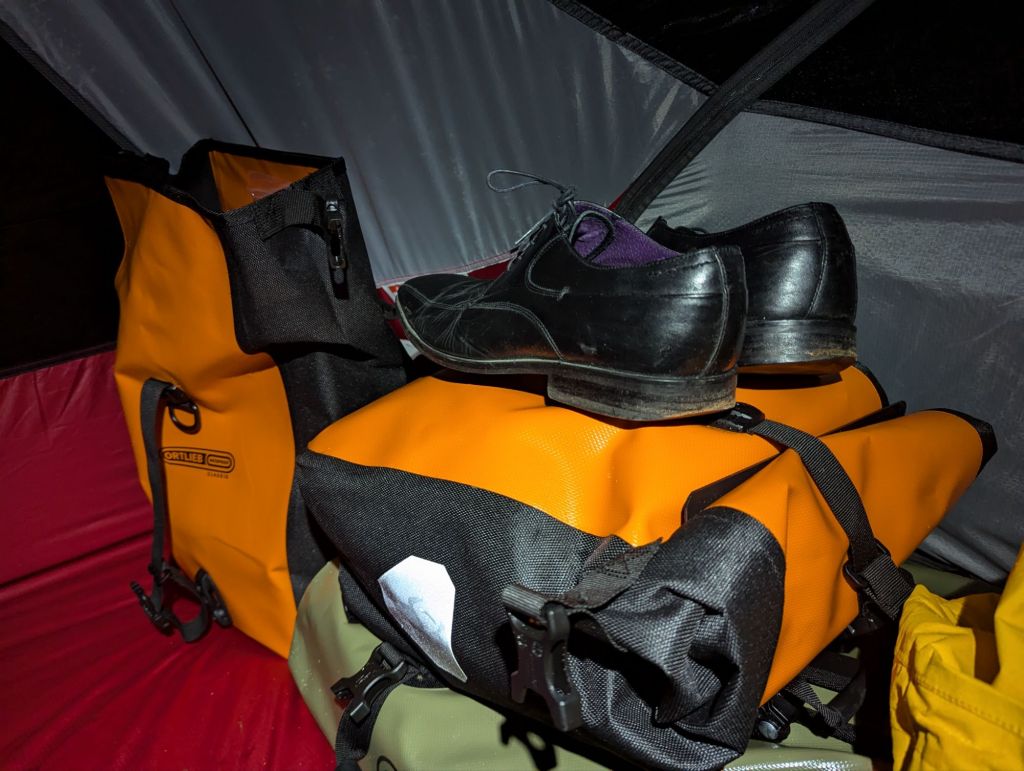
    Priorities: the dress shoes were still dry, but the tent floor not so much

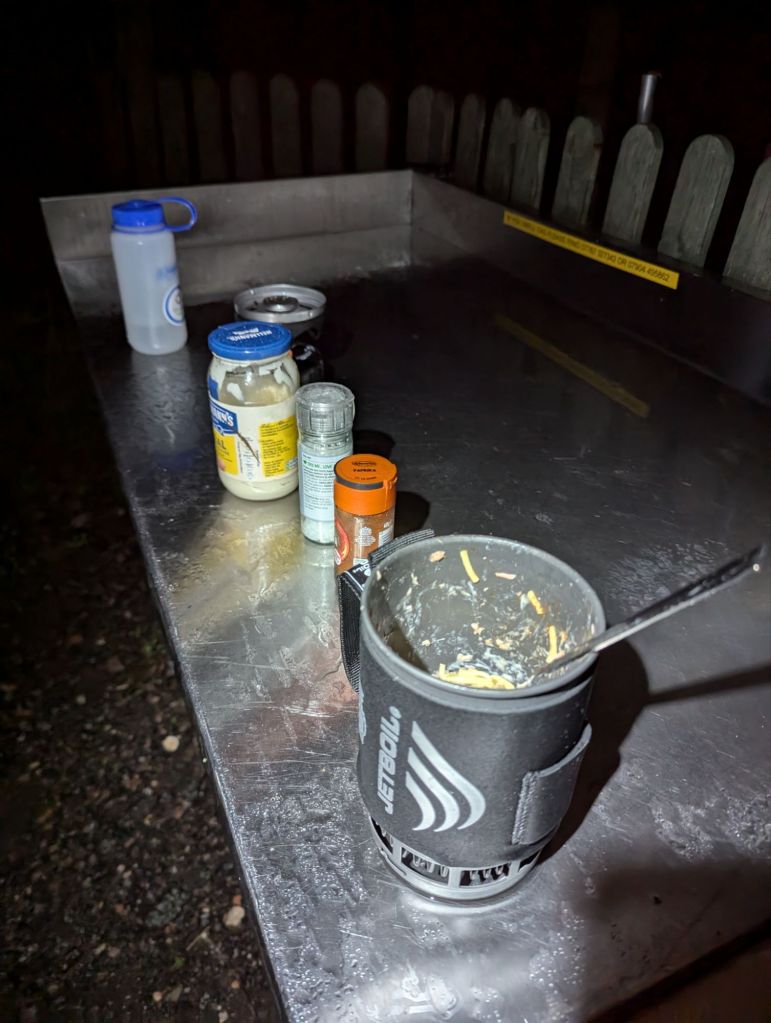
    With the tent pitched I moved on to matters of an evening meal. It was now 10pm and I had been surviving thus far on a prematurely devoured Cadbury’s Easter egg (sorry Jesus) and a few remnant wine gums from a jumbo 350g box I had received as a birthday gift. Wine gums are my go-to sugary snack on the bike, preferably Maynard’s but I’ll give any version a try, however I now needed some proper food after such a hectic and tiresome day. So I conjured up a meal from the food I had salvaged from the clear out of my kitchen and squeezed into the panniers…two packs of dried egg noodles, one can of tuna chunks in water, and a good dollop of mayonnaise – I don’t know how that sounds to you, but I can tell you it was like manna from heaven, proper lush!

    Tuna, mayonnaise and noodles, you heard it here first

    Day 2 – These hills were made for walking

    After the chaos of day 1, the morning of day 2 was a welcome contrast. The rain had passed, and a gentle warmth began to fill the tent as the morning sunlight lit up its red and white angular walls. The trains continued to whoosh by, but they went unnoticed in the peace of that moment, and with the biggest admin hurdles now cleared I could focus on the bike touring and getting an oven-ready plan for Europe.

    The morning after the night before

    After a relaxed morning packing up the bike I set off and continued on my north-easterly trajectory towards the Peak District, trying my best to avoid the urban sprawl of Stoke-on-Trent. As a cyclist you find there some areas that just cannot be traversed without going along at least a few busy roads, this part of Staffordshire being one of them.

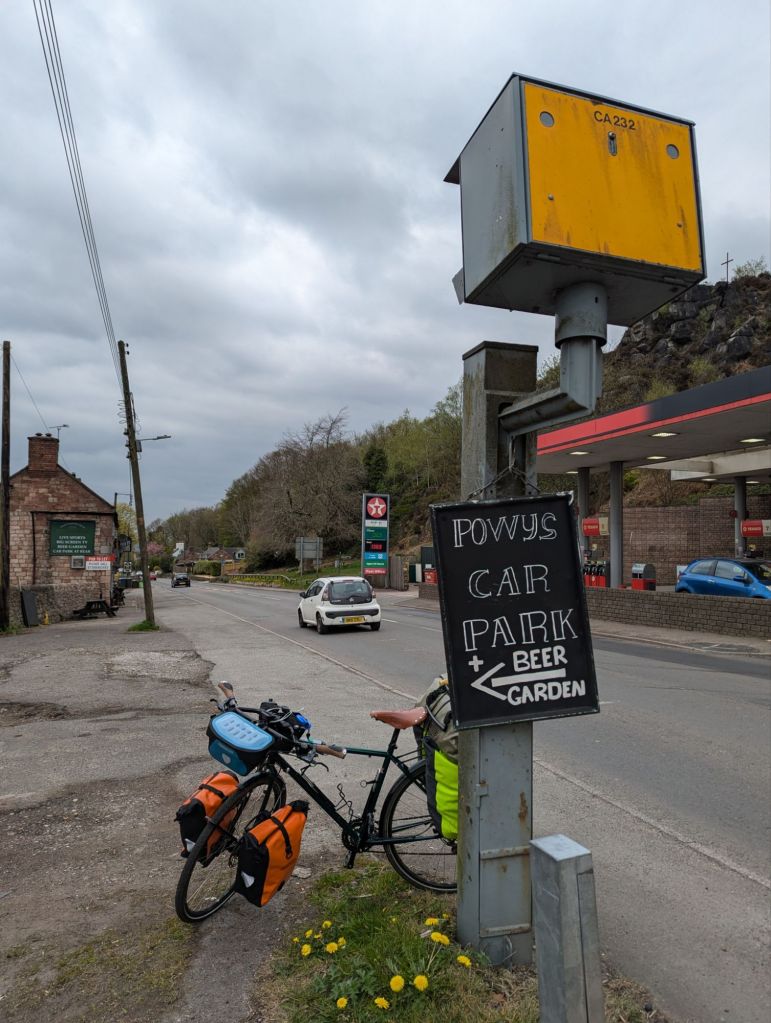
    If anyone knows what the hilltop crucifixes opposite the Powys Arms on the A520 are all about, let me know. No googling

    I would soon start ticking off ‘firsts’ along the way. My first stop at a shop might sound pathetically kindergarten, but the theft paranoia is real, especially when you have never left your new bike and panniers alone in the big wide world before. But guess what? I locked the bike, went into the shop, came back out and et voilà: it was still there, panniers and all. And if any prospective thieves are reading with a ruminating intent to steal from me – unless there is a high demand for unwashed underwear in your area – I don’t leave anything worth nicking on my bike, and if you pinch it anyway, I will find you and I will write about you.

    The flat plains of north Shropshire were fast becoming a distant memory as the inclines began to rise. I was entering the foothills of the Peaks, and had to face the reality that I was riding an extremely heavy bike. My touring bike is fitted with a mountain bike gearing system, including an invaluable third ‘granny gear’ on the front set of cogs which gives you the option of a nice easy gear to pedal on the steeper hills, at the cost of moving extremely slowly. The slower you ride a bike the more of a balancing act it becomes, so it is a skill to be honed over time. The best advice I can offer is to leave yourself a buffer zone from the edge to avoid striking your pedal against the kerb and/or getting too boxed in by passing vehicles, and if you ever feel the need to stop simply put your foot down onto the kerb/verge (rather than back into the road).

    Before long I was in the realm of hardy hill sheep with a fresh batch of spring lambs hopping around as if their legs contained actual springs, occasionally on the backs of their unamused looking mothers. I had entered the Peak District, and it was here I would face my first properly STEEP hill.

    Cast your mind back for a moment to trigonometry class and your protractor (that transparent semicircle of cheap plastic we all carried around in our pencil case), the difference between 6° and 12° doesn’t really look like much: these are the approximate angles of a 10% and 20% climb, and when tackling such inclines on a fully loaded touring bike it is the difference between a minor skirmish and nuclear war. I tried my best to ‘punch’ my way to the top of these climbs (in other words, pedal bloody hard to try and keep a good momentum) but it was just not possible for me to sustain this intensity to the top of the longer climbs. So I swallowed my pride, hopped off the saddle and succumbed to my second hike-a-bike of the trip so far.

    Summit at last – a typically moody outlook across the southern Peak District

    At around 6pm in dry conditions with plenty of sunlight ahead, I rolled into what I thought would be my chosen campsite for the night. Now I don’t know exactly what goes on at an ‘adults only’ campsite that would not occur at their family friendly counterparts, but as a man without children I am not against the idea of retaining a few safe spaces to escape the sights, sounds and occasionally smells of other people’s offspring (or perhaps even your own whilst the folks are on grandparent duties). However, I did find the prices at Longnor Wood adult only holiday park to be a bit on the spicy side for my taste, so I continued on to nearby Crowdecote which had the trifecta of a campsite with stunning views, a pub within walking distance, and the satisfying attribute of being just across the border into Derbyshire – a county transition always feels like good progress.

    Day 3 – To cycle, or not to cycle

    Clearly there will sometimes be days on a long cycle tour where, for some reason or another, you don’t do any cycling. Whether you are rained in, ill, travelling by other modes of transport, having fun doing other activities, writing blogs, the list goes on. The morning after my unexpectedly cold night camping in Crowdecote I was met with the arrival of considerable volumes of rain and, more concerningly, wind. Today there would be no cycling (well, at least no fully loaded cycle touring).

    The Mummy Returns – keeping warm and toasty on a chilly night in the Peaks

    The decision was made to camp an extra night, do a bit of shopping in nearby Buxton, and make the most of The Packhorse Inn’s cosy fireplace, where I soon noticed my fellow campsite neighbours had also taken refuge from the cold with a pie and a pint.

    The following day was a much calmer affair on the weather front, so I packed up my ever expanding collection of belongings and got back on the road. I now had some real world experience in riding the loaded bike and utilising the camping system, with some ideas for where improvements could be made (mainly around the reduction and rebalancing of luggage), so I decided to head for the nearby city of Sheffield and hop onto a train to expedite the remaining journey north.

    The notion was simple but the act was far from it; one does not simply ‘hop’ onto a British train with a fully loaded touring bike. The train operating company in this instance was CrossCountry Trains. The first hurdle is the famous gap between the train and the platform edge, which at some stations can be quite a chasm, before being met with a double-step up to the floor of the bicycle storage area. I actually had no idea if I would be physically capable of lifting the bike onto the train fully loaded, but the idea of removing panniers from my bike and loading everything in multiple trips amongst the bedlam of passengers coming and going was too much for my nervous system to handle at that point in time, so when the train doors opened and the crowds dispersed I raised the relatively lightweight front of the bike up both steps onto the train floor, planted my foot on the step and rolled the bike forward until the back wheel was touching the edge of the step…I took a deep breath and heaved both myself and the bike onto the train in a deadlift-like forward motion. This worked surprisingly well.

    On CrossCountry the bike storage is invariably a vertical rack, whereby the bike needs to be raised onto its back wheel then lifted onto a hook. Now call me a wuss, but this is at best an awkward manoeuvre with a regular unladen bicycle, and a fairly Herculean task with a fully loaded tourer. Now I’m quite partial to a spot of day dreaming, so whilst waiting for the 18:30 to York my imagination was conjuring up visions of an empty, easy to access spot where I could simply lean the bike and secure it with a strap. But fantasy and reality are rarely one and the same.

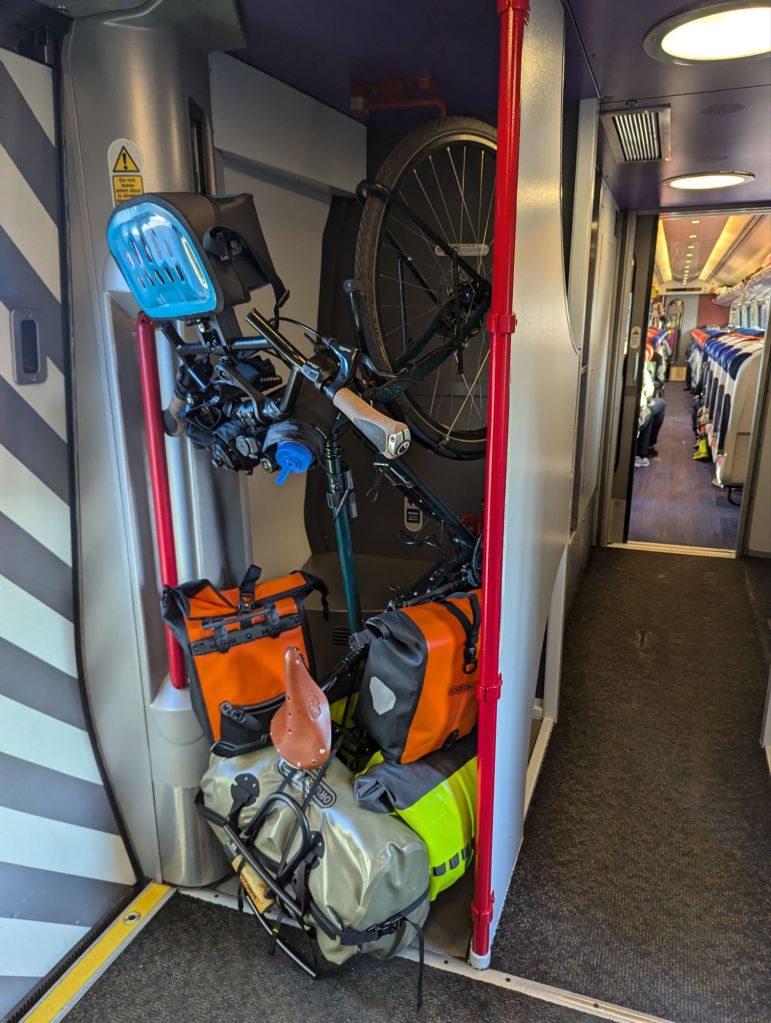
    In the stress of the moment of boarding the train I decided that attempting the ‘vertical bike’ manoeuvre was too difficult and explained to the guard I would happily move the bike before our stop at Doncaster to allow people to alight, to which he replied it was a health and safety requirement for the bike to be upright. Looking back I don’t know why I didn’t just deal with the faff and remove all my panniers, but instead my solution was to remove only the front two orange bags, flip the tourer on its hind legs, then wedge the whole thing into the compartment until it could be wedged no more. The train guard returned, raised a bemused eyebrow at the spectacle in front of him, and concluded the situation was now safe and healthy enough for the remainder of our journey.

    Not the natural orientation of any bicycle, unless you can do 90° wheelies

    I took a welcome break from camping at my generous aunt Margaret’s house in York, whereby I took the opportunity to rest, refuel and sort out a few admin tasks relating my phone’s roaming, latter turning out to be more of a pain in the arse than I could ever have imagined. The next day I took a train to Eaglescliffe and rode the final few kilometres to our family home.

    I expect to make various train journeys with my touring bike throughout the tour, whether these be a short hop under a mountain pass, or skipping an entire country when the clock starts running low on my 90 day Schengen area visa (sponsored by BREXIT means BREAKFAST), so it was good to get on the scoreboard during the UK mini tour, which was now complete.

    PHOTOS: UK mini-tour

    STRAVA: Day 1, Day 2, Day 3

  • 1. Preparation is all you need

    Packing for a two week holiday can sometimes be quite a challenge. You either burden yourself with 14 days of clean clothes to lug around in transit, or conjure up in some kind of plan to do laundry in between the more holiday-like activities. Maybe you have your own solution involving the inversion of underwear, but whichever option you go for it will involve some kind of trade-off. If struggling with heavy suitcases and trips to the launderette are not your cup of tea, maybe you’re an underwear inverter?

    Packing for an eight month cycling trip requires trade-offs on different order of magnitude. The limitations are obvious – all your earthly belongings will be carried along in bags attached to the bicycle, the more you bring, the heavier and more unwieldy it will become to ride. Everything you need to wear, cook, eat, sleep, entertain yourself, and (hopefully not too often) fix a broken bicycle needs to be distilled down into the smallest size, weight and quantity that is acceptable to your personal needs and tolerance for inconvenience. It is an all out trade-off war and you will be paying the tariff for extra goods in your legs.

    The problem with planning something like this for the first time is that you don’t really know what you will find to be an acceptable inconvenience to live without and what will be worth carrying the extra weight. The dizzying amount of choice on offer for how to pack for a major tour can be overwhelming at first. To my knowledge there is no cycle touring Bible, Haynes manual, or other one-stop-shop of ultimate guidance in this regard, so my strategy was to harvest knowledge from experienced and credible sounding folk on YouTube and get started before the options paralysis took hold. Everyone does it their own way, but you soon get a feel for the commonalities between different approaches and where the key trade offs lie.

    Anyone who has worked with me will be unsurprised to read that I planned this trip with the help of a spreadsheet, allowing me to track the procurement status of everything I might (or might not) need. So whilst I tried my best to be organised, there were several notable challenges to overcome before the scheduled day of departure: finish work, move house, and partake in a choral performance of Bach’s B Minor Mass. If you can avoid including all three of these activities in the final preparations of your own logistical endeavours, I would recommend it.

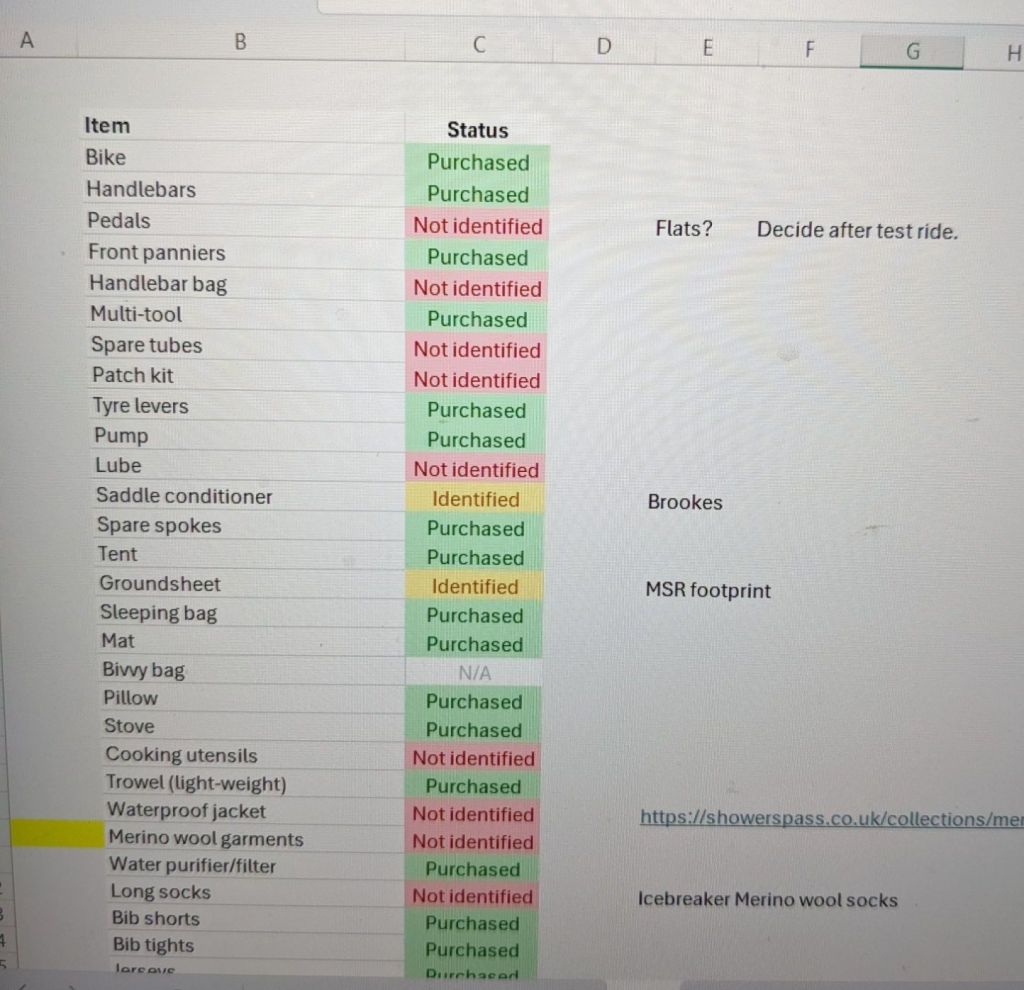
    Excerpt from an early version of the spreadsheet tracker. Still undecided on pedals, but at least I have a trowel.

    I essentially put all tour planning on hold whilst working the notice period of my job, leaving me exactly one month to prepare for the trip, sing the mass, and move out of my flat. Except you can lop a week off the front of that for a bit of decompression time and a family trip down to London. What followed was a maelstrom of researching what gear to bring (or not), internet shopping, farewell drinks, choir rehearsals, vaccinations, furniture donations and bill cancellations. Amongst the chaos I hung onto that spreadsheet for dear life like a tabulated piece of flotsam, keeping my head just about above water as the waves rolled in.

    Moving house is a headache regardless of the circumstances. Despite hauling two Transit van loads of ‘stuff’ from my flat in Shrewsbury 200 miles across the Pennines to the family home in Teesside, it was inevitable I would forget to pack something. What surprised me was how many forgotten items came to emerge from forgotten corners of the flat – drawers rarely opened, pictures hung on walls seen so frequently they had become invisible – the bulkier objects would have to go to one of Shrewsbury town centre’s numerous charity shops, but surely there would be spare room in the bags to bring some smaller items home if I called in on the way, wouldn’t there? So despite having no use whatsoever on my trip, a variety of oddball items were placed into the panniers for the initial UK ‘mini-tour’ from Shrewsbury to Teesside. This mini-tour was always going to be my chance to stress test the fully-loaded bicycle setup whilst firmly on British shores; now with extra items to bring along, the touring bike was to become a cargo bike, and a heavy one at that.

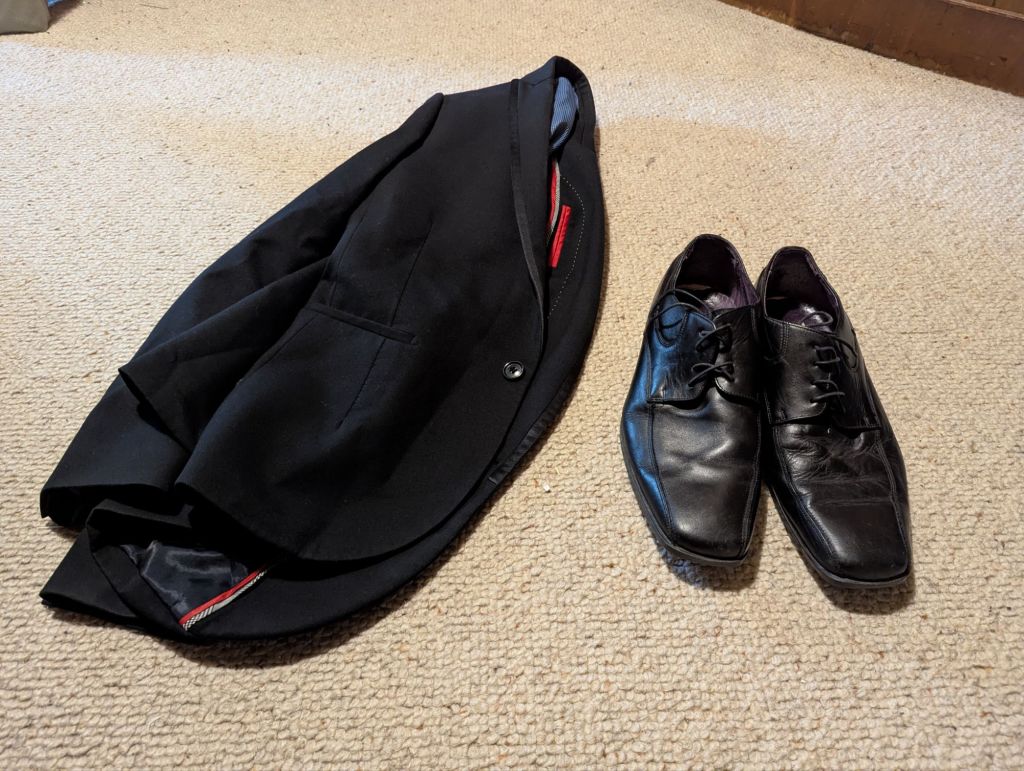
    Now I’m not saying never take a suit jacket and smart shoes on your cycle tour, but they will not be going back into my panniers any time soon.

    The ‘Grand Depart’ was scheduled for Monday the 14th of April, when I would hand in my keys to the flat and set off in the general direction of north-east. The final weekend soon arrived, at which point I was effectively camping in my flat without a bed or more importantly a TV. Our choir, Shrewsbury Choral, performed Bach’s stunning B Minor Mass in the divine setting of Shrewsbury Abbey,  leaving only one major challenge remaining; how would I actually attach this worryingly large pile of stuff – increasing in with every Amazon delivery – onto the bike?

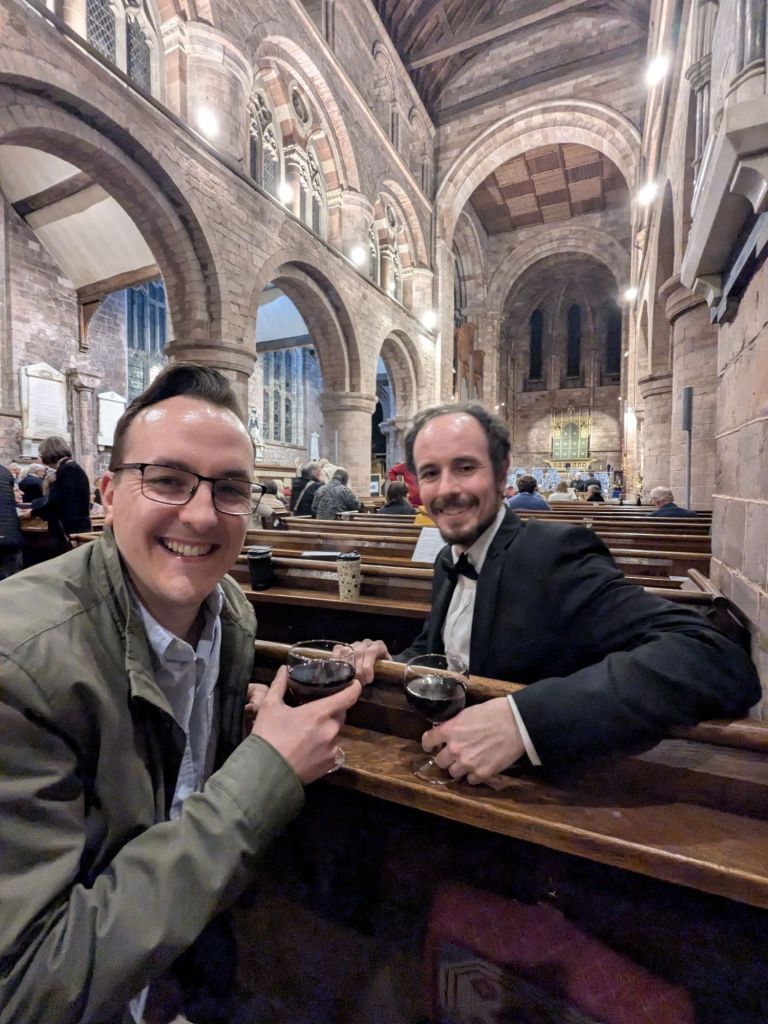
    Me (right) with my supportive friend Tom during the interval of Bach’s B Minor Mass. It looks like I was on the red wine but I swear it was the photographer Andrea’s!

    After several rounds of packing, unpacking, swearing, rejigging, discarding, and more swearing, the fully brimmed panniers were finally secured onto the bike, hoorah! Now to just lift the bike downstairs, 3, 2, 1 and lift…I said AND LIFT! To say “that is one heavy-ass bike” would in some sense be anatomically accurate: the majority of weight was held within the rear luggage bags and in particular the large ‘rack bag’ that sits on top of the rear panniers. I would later find out this front/rear weight imbalance can have some rather unpleasant side effects when it comes to actually trying to ride your touring bike.

    With the flat keys handed in, and after a brief false start where I had to turn back and collect my trusty old D-lock, I clambered onto the now bulging bicycle and looked up at the white sash windows of a flat that was no longer my home, but just another Georgian building in a historic townscape. I turned on the GPS, gave the bike a small push to get it moving, and started pedalling towards Staffordshire. The mini-tour had begun.

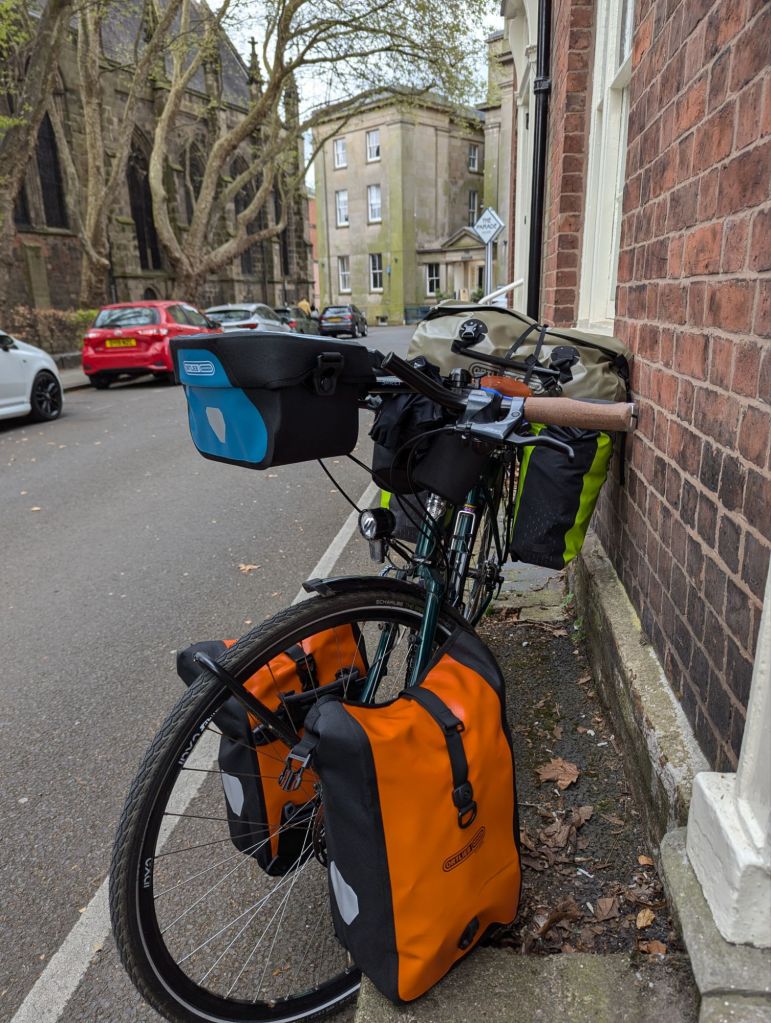
    My bicycle, a ‘Wayfarer’ made by Spa Cycles near Harrogate, fully loaded and ready to roll.