
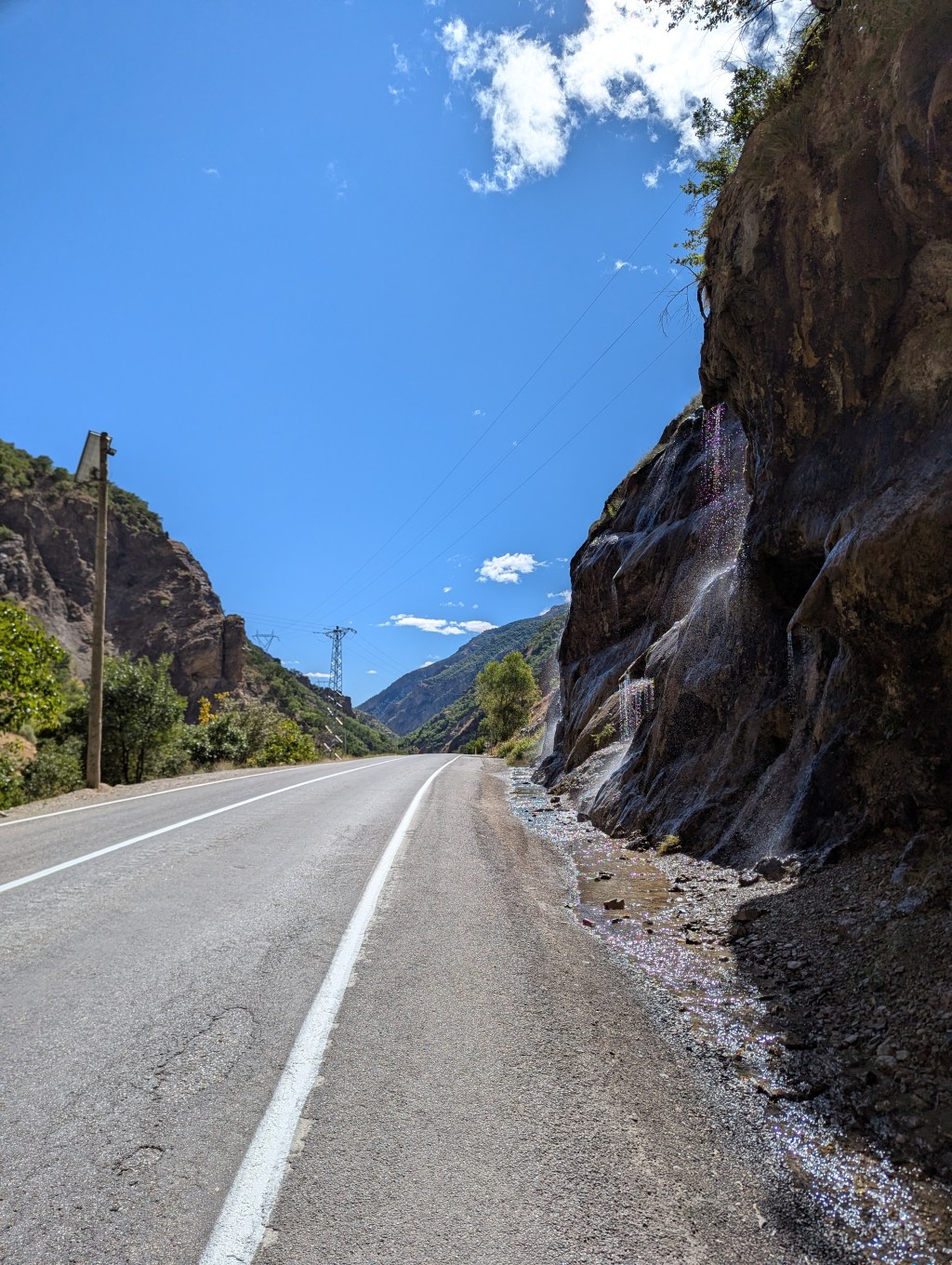
At roughly the size as Stoke-on-Trent, Erzurum is nestled in the corner of a mountain plateau at the foot of a popular ski resort. Known as Karin to the Armenians and Theodosiopolis to the Byzantines, it is one of these strategic sort of places that was passed back and forth between empires over the centuries – presumably to secure access to the ski resort. Erzurum is often cited to exemplify the quintessential socially conservative Turkish city; it is a long way from the boozy Mediterranean beach resorts frequented by sun seeking Brits.
Otel Çınar turned out to be a slight step up from my bargain basement hotel in Kars. The wall behind the bed had a rather fancy integrated wooden headboard with backlit trees, intricately carved by the machine of mass-production. The wet room was blessed with a functioning shower with a head that didn’t blow off the hose Laurel & Hardy style, not even once – but perhaps the hair dryer plugged into 230v mains within arms reach of the shower wasn’t a design choice optimised for staying alive. Funnily enough I don’t use hairdryers on the regular, but if you do, maybe opt for somewhere drier than a wet room.
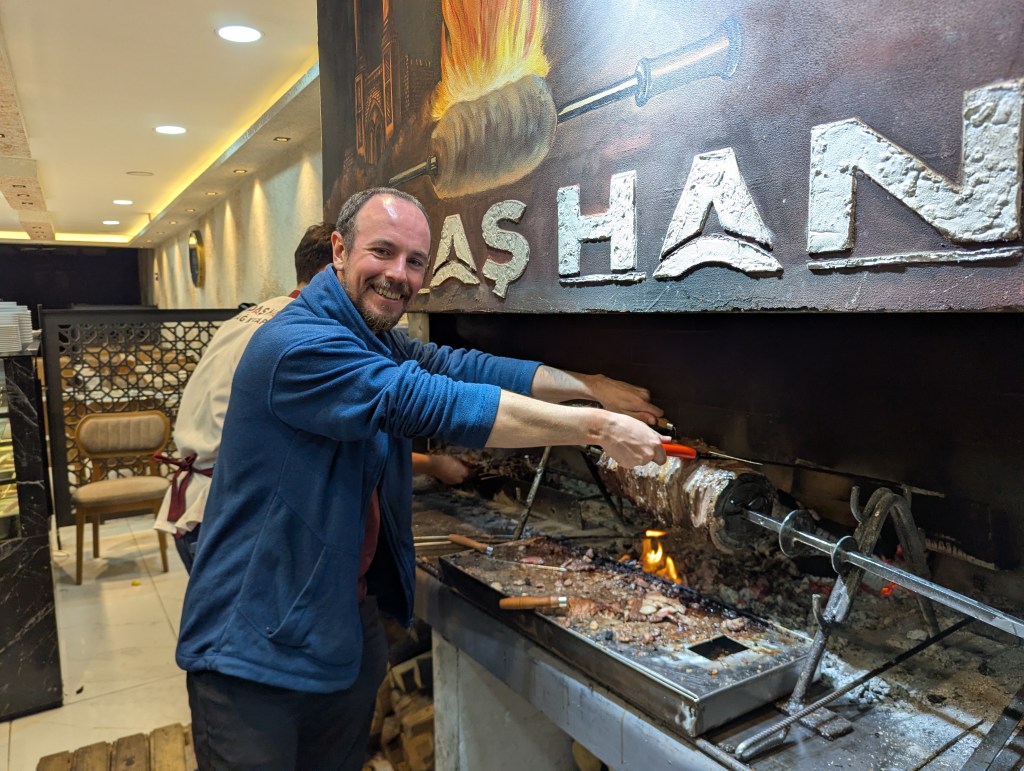
The time had come to make good my word to the military police and track down their recommended local grub: ‘jah kebab’. I think the penny dropped that my Turkish skills were seriously failing after the fifth kebab shop in a row with Cağ kebab either in the name or top of the menu, and without a ‘jah kebab’ in sight. In Turkish, C is pronounced like an English J and the ğ is silent (the latter serving only to lengthen the preceding vowel) – mystery solved then.
With cağ kebabs, the lamb meat is marinated then cooked horizontally over a charcoal fire rather than the familiar vertical setup. The cooked meat is served by the skewer, making it quite versatile for variable appetites; it would be quite easy to lose one’s inhibitions and rack up a sizeable bill/bellyache, so make use of that complimentary bread-basket. And if the restaurant’s quiet the chef might let you pose for a photo like an alien who’s never held a knife before.
Breakfast was in the hotel lobby where my bike had spent the night. It was practically on display to passers-by ‘shop window’ style, but it would take a brave thief to steal from a Turkish hotelier’s guests in a city like Erzurum. I sat munching through a basket of bread & honey and gazing out onto the street. The neighbourhood was a hub for commercial kitchenware, offering stacks of copper tea pots and mirror-like polished stainless steel pots & pans, some big enough to boil a small person. The vendors weren’t exactly inundated with customers, and spent fair chunk of the day out on the street smoking cigs, sipping çay, and having a good natter. With quite a lot of goods displayed out on the street, you can feel the burning glare of neighbourhood watch in action; good luck to any thief caught red handed by these guys, they might just end up with a new found appreciation for the length and curvature of an Ottoman-style İbrik coffee pot spout.
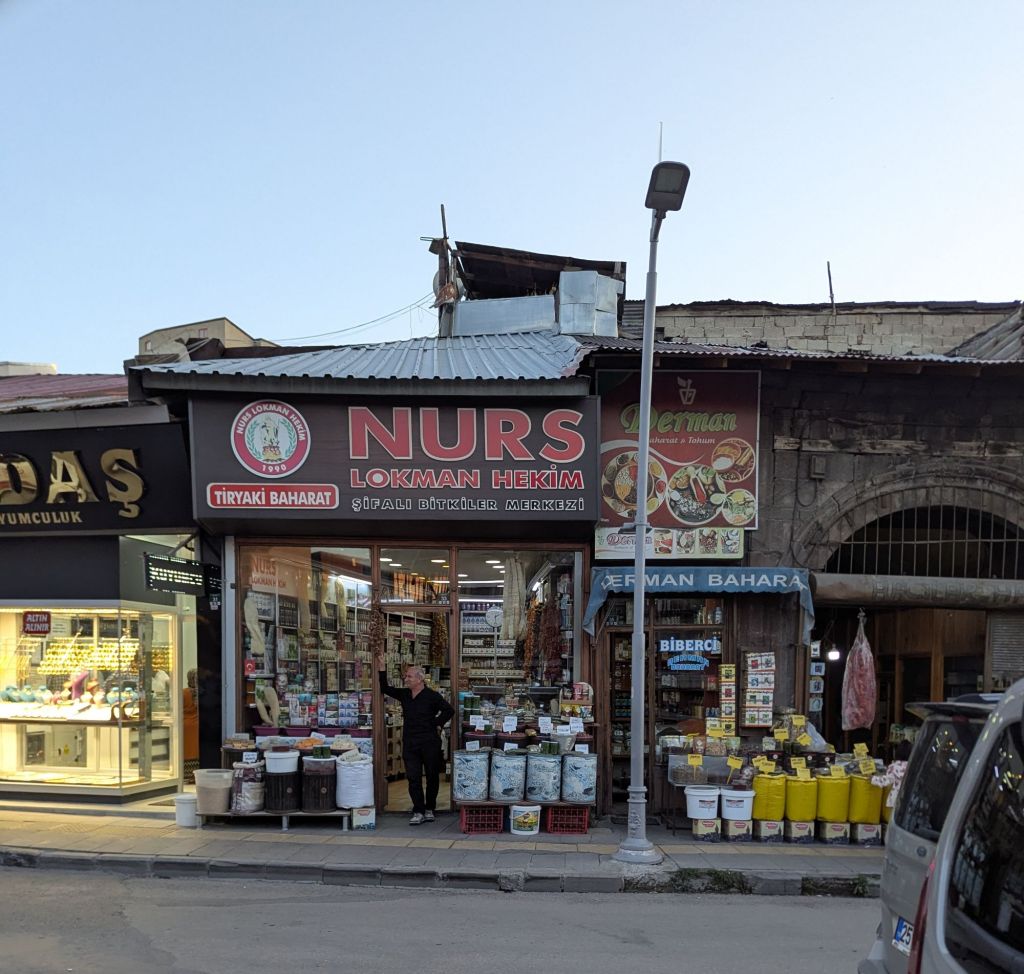
It must be quite easy to shop around for a good deal in Erzurum since the merchants tend to congregate together into mini districts: I was staying in the catering supplies hub, just around the corner it was furniture and gold jewellery. The most striking example has to be inside the 16th century Rustem Pasha Caravanserai – a former travellers inn with dozens of rooms surrounding a central courtyard – which nowadays is filled with craftsmen and jewellers specialising in the local Oltu Stone (basically Erzurum’s version of Whitby jet).
Seeking out Kurdish Turkey
“There is no such place as Kurdistan.”
That was the response my Irish friend received from a local Turk when describing the region he would travel through on his way from Kars heading south into Iraq & the Levant. I don’t know whether he was being deliberately provocative or just clumsy, but the mere insinuation of an independent state in Turkey’s Kurdish majority south-east region could land you in a spot of bother in the wrong company, including the police.
Kurds are the largest ethnic minority in Turkey – about 1 in 5 of the population – with similar populations in neighbouring Syria, Iraq and Iran. Kurdish languages are Persian in origin making them completely unrelated to Turkish, and whilst the majority of Kurds follow Sunni Islam there is a lot of diversity within the historically tribal Kurdish culture. My untrained eye had been looking for hints of Kurdish society since entering Turkey but without much success; there were no signs written in Kurdish, and the only confirmed Kurd I’d managed to find had explicitly introduced himself to me at Kars castle.
It seemed I was still a bit too far north. The geographic boundaries of Kurdish Turkey are somewhat fuzzy, but from the maps I’d seen it looked like Tunceli and Elâzığ were within its outermost provinces. The road to Tunceli would also get me off the main road for a few days and the satellite imagery revealed green forested valleys, ideal for wild camping.
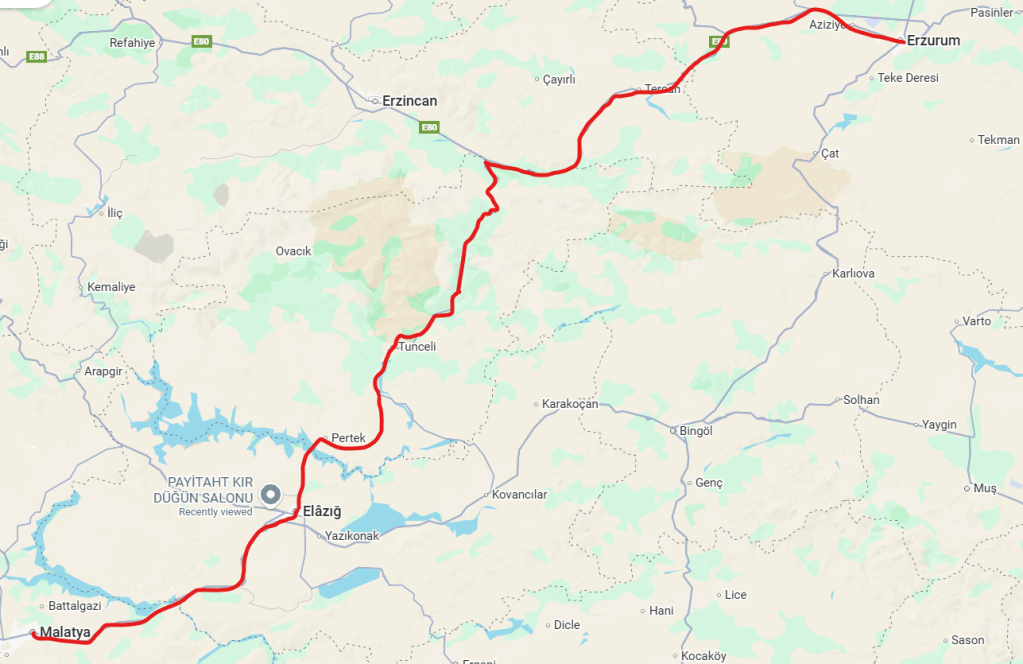
The road heading west out of Erzurum is a busy dual carriageway with options to safely pull over few and far between. In need of lunch, I took the exit into the small village of Çayköy where the local mosque’s leafy garden had an invitingly shaded picnic area, patrolled by a resident cockerel and his flock. Mosques make for perfect resting places since there’s generally at least one in every town and village, where they are a reliable source of public toilets and somewhere to sit. I’ve heard you can even sleep in them if you ask the custodian nicely. Thinking back to my first night in the Talysh Mountains of Azerbaijan where the police sent me on a wild goose chase in search of non-existent hotels with vacancies, I could have just cut my losses and taken refuge at the mosque.
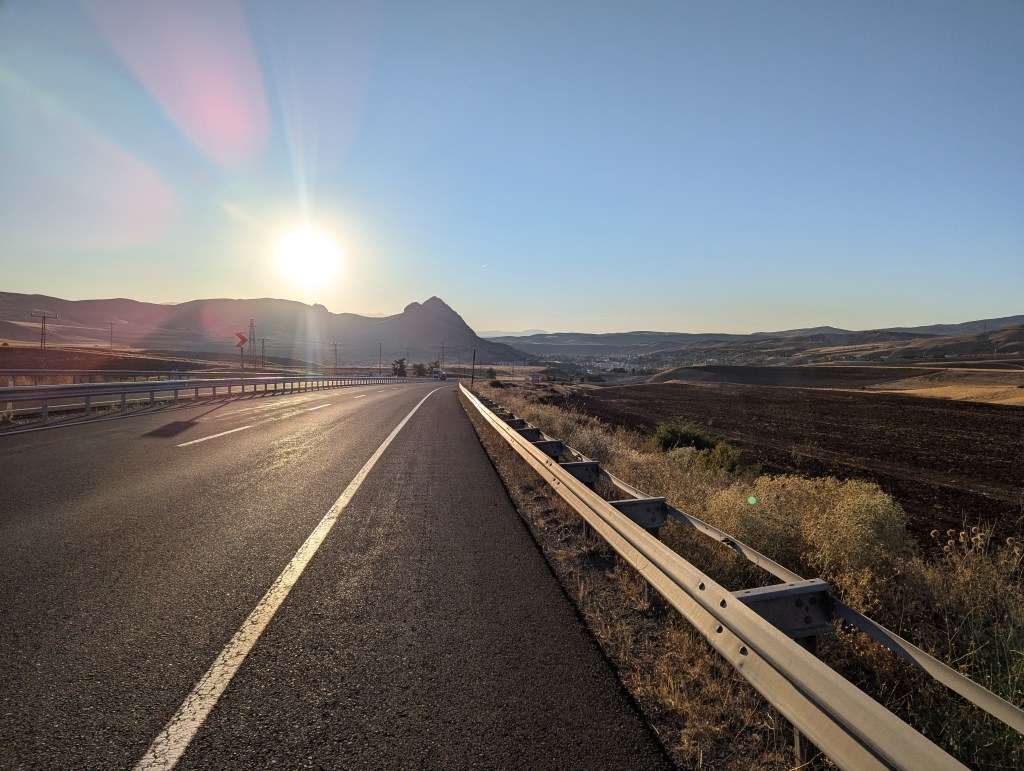
As the sun set and darkness set in, I realised that main roads are a lot better at ‘getting the miles in’ than they are for stumbling upon decent camping spots. I eventually turned off the dual carriageway to do a reccy along a small dirt track that led over some fields when two loud blasts ripped out across the pasture; someone had a shotgun and I didn’t fancy hanging around to find out who.
By the time I rolled in to a truck stop near the small town of Mercan it was time to call it a night and grab some dinner. I’d read on another blog about a cycle touring couple who liked to camp next to petrol stations – which come with the convenience of a shop and toilets – but it was dark, littered with rubbish and patrolled by stray dogs; I cut my losses and checked into the nearby Grand Karagül hotel. I can’t help but feel a sense of guilt and failure when I have planned to wild camp but end up in a hotel (especially a bougie one), but without the Scandinavian midnight sun to guide me it was getting hard to spot a good campsite beyond 7pm, and I just wasn’t mentally prepared for a night of broken sleep along a dual carriageway to the soundtrack of exhaust pipes, tyre roar, and flapping straps.
Roadkill Buzzkill
There are some darker sides to cycle touring. Over time, anyone who gets in the miles will encounter a whole variety of deceased animals. In Britain this would typically include badgers, pheasants, hedgehogs, squirrels, even the odd deer, but since arriving in Azerbaijan I’d seen owls, eagles, rats, cats…even an otter. When it comes to sizeable roadkill, by far the most common sight in this part of the world are dogs. It is a sad reality that the lives of street dogs are often cut short on the roads they call home, with predictably gory consequences. The victims often lay along the road’s edge and can pose a serious risk to cyclists.
It’s never a joy encountering roadkill, but to be honest after a while you get used to it. One thing I’ll never get used to is encountering animals that have been hit by vehicles but are still alive.
With a solid night of hotel-grade sleep under my belt I was packed up and ready to take on the day. During the customarily awkward battle between loaded bicycle and the hotel’s self-closing door mechanism, the piercing yelp of a dog in pain rang out across the car park. The poor bugger’s left leg had been ran over, leaving it degloved and probably broken.
This was not a scenario I had mentally prepared for. The only thing I could think of doing to help was to offer half of the beef sausage I had bought for my lunch, but the animal clearly wasn’t hungry. A man walked by and muttered something in Turkish whilst shrugging his shoulders. My only hope was that if there is an organisation you can call at a time like this, hotel management would have the knowledge and motivation to do so given the disturbing scene unfolding at the entrance.
It was a bad start to the day.
—————
The day began at the confluence of two rivers which mark the beginning of the Euphrates. A bit like the Nile, the Euphrates is a major river flowing through an arid climate, making it a vital artery for the communities that live along its banks, all 2,700km of them. Since the region’s other major river, the Tigris, also starts life in Turkey, Syria and Iraq are at the mercy of Turkey’s Ministry of Agriculture & Forestry when it comes to the quality and reliability of outflows from these critical river systems. As an island nation, Britain is at the mercy of no one but itself when it comes to water quality, where every time the rain pours, bursting sewage works spew torrents of shit into our rivers, streams and shorelines.
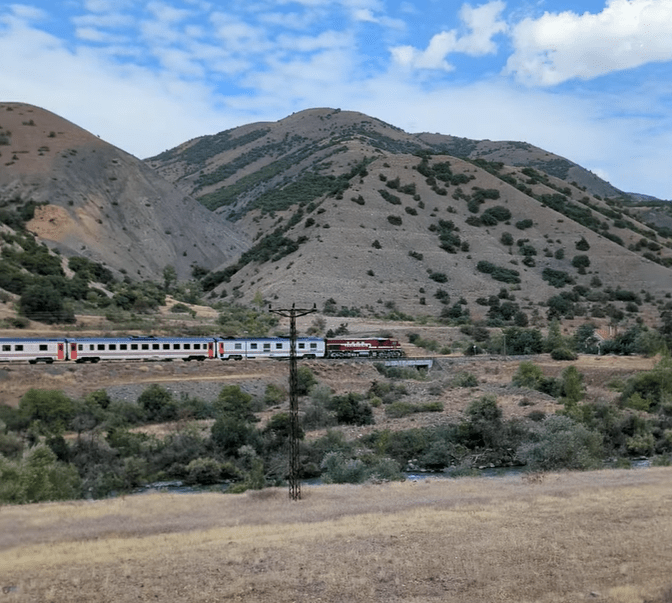
With the Euphrates to my left and the Eastern Express Ankara-Kars railway to the right, I meandered down the flat dual carriageway surrounded by mountainous terrain in search of the junction for Tunceli. Exiting a main road is usually quite routine, but to spice things up this one had a c.300m long tunnel just before the turn off. I considered myself somewhat of a tunnel veteran by this stage, but through a combination of forgetting to remove my sunglasses (thus plunging into darkness on entry), riding the precariously narrow gap between white line and gutter, and becoming a rather thin slice of bread in an articulated lorry sandwich – well, these are the moments that test your nerve on a bicycle tour. Just hold steady and pray to the pothole gods for safe passage.
The oak forests of Pülümür Valley
On exiting the Tunnel of Doom still in one piece, I recuperated over lunch at a dilapidated picnic area where careless travellers had left the place in desperate need of a litter pick. From here the road slotted under the motorway to head south into the mountains, where around twenty switchbacks and 750m of climbing lay between me and the next town. I didn’t really know much about the valley I was heading towards other than the fact it looks quite green and lush on the aerial photos, at least by Anatolian standards anyway.
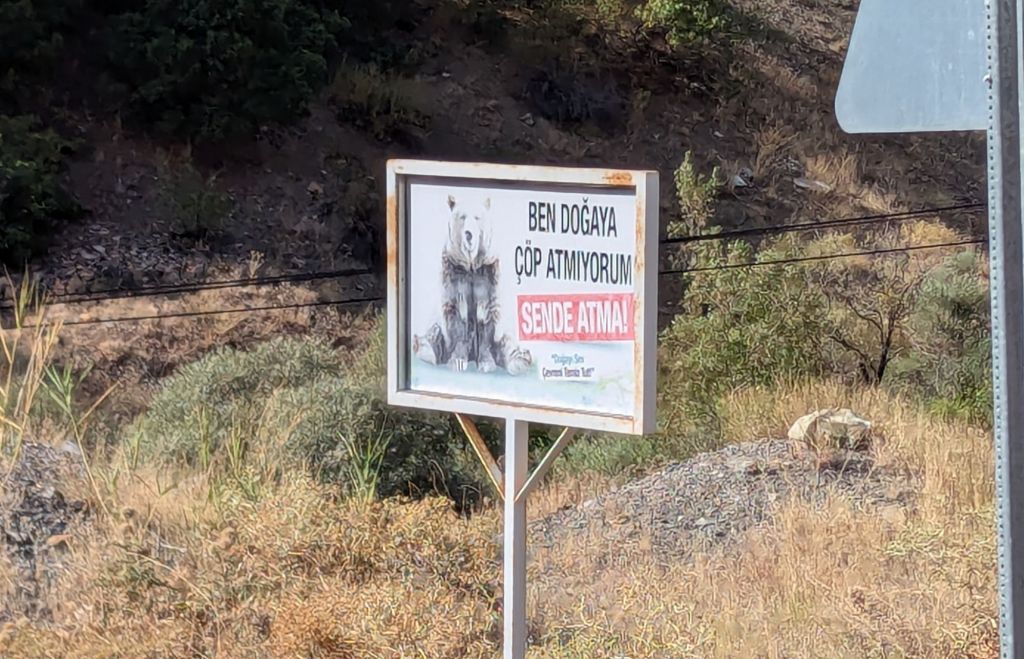
Most sign posts don’t warrant a second glance, but when they feature a large bear with the words “SENDE ATMA!” splashed across in red & white…it’s time to whip out Google Translate. It said something along the lines of “I don’t litter, so neither should you”; a gentle reminder I was about to re-enter brown bear country.
The beads of sweat on my head had attracted the attention the local fly population, who themselves were on the radar of birds that would swoop down pluck a fly out of thin air in a flash of colour. On cresting the summit the road descended into the Pülümür river valley where, all being well, I intended to camp that evening. In fading light after a plateful of the only dish they had left at the village cafeteria, I found a stretch of flat ground around 4km down the road beside the river.
It was by most metrics a great camping spot: flat, away from the road and surrounded by nature. But whether it was the lingering thought of bears lurking in the trees, or the nervous afterglow from being unable to help that poor dog followed by a tight squeeze through the Tunnel of Doom – I was undeniably ‘on edge’. Now relying on my headtorch to pitch the tent, my eyes adjusted to the brightly lit vicinity of the camp leaving me surrounded by a wall of jet black darkness. As I pegged down a corner, a short but distinctive burst of white noise emanated from the void which my jittery brain interpreted as the hiss of a substantial cat, something like a caracal.
“Whatever you are, wherever you are, GO AWAY. GO AWAY AND LEAVE ME ALONE!!”
Brandishing my 2kg Kryptonite D-lock, I set the headtorch to full beam and systematically scanned the area, shouting out in an effort to sound vaguely threatening. There was nothing to be seen. I’ll never know if that hiss was a lynx, caracal, someone’s housecat, or simply a splash of river water twisted by a heightened state of alert. It didn’t matter now: with my food stashed safely away from the tent up a tree like a goodie bag for passing bears, I could kick back and bask in the sanctuary of the tent. Thin canvas walls punch well above their weight when it comes to emotional protection from the terrors of the night, whether they are imagined or otherwise.
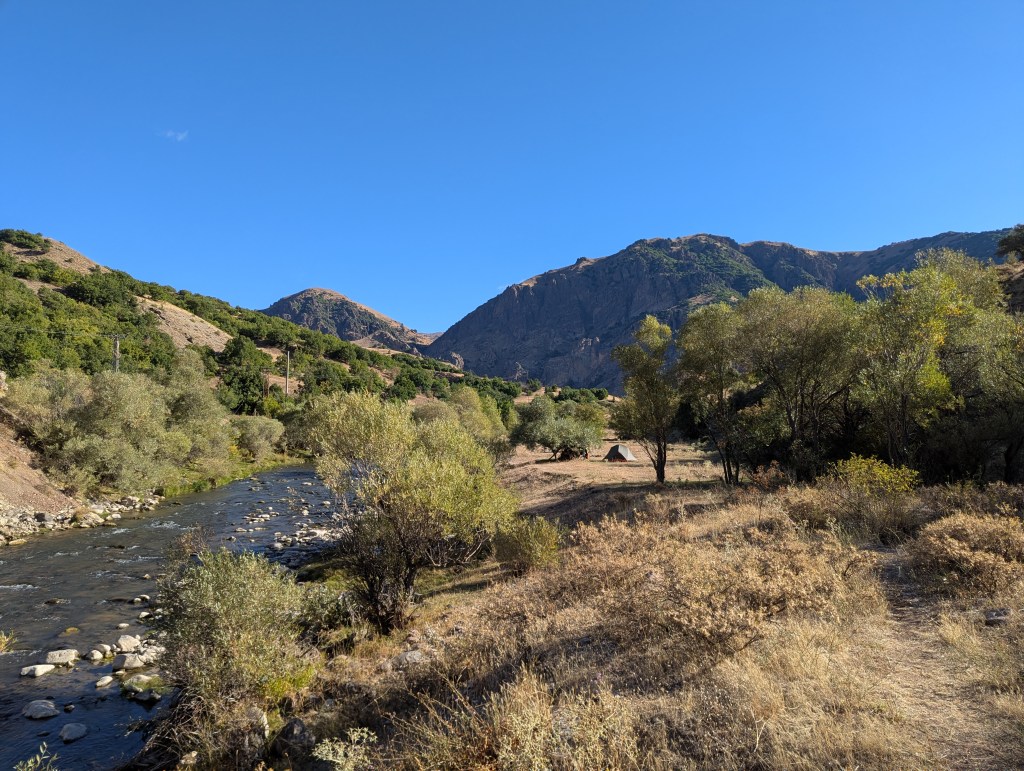
Any lingering paranoia soon evaporated with the morning sun. The valley was much greener than what I’d become accustomed to in Turkey; the tent sat beside the gnarled trunk of an old olive tree, the riverbank was peppered with green shrubs and grasses, and the valley slopes were a patchwork of oak woodland, scorched grass and rugged cliffs.
The route was downhill through a stunning valley in perfect conditions: it was the perfect start to a ride. But sometimes fate has other ideas. The asphalt road was of a speckled variety, which is my excuse for not seeing the small but formidable hazard that lay ahead.
**BANG**
Punctures can silently creep up on you, but this one felt more like an IED with the front wheel jolting into the air on impact. The culprit was a nail, and the pointy end had gone through my armoured Schwalbe Marathon tyre like it was warm butter. A roadside repair was in order.
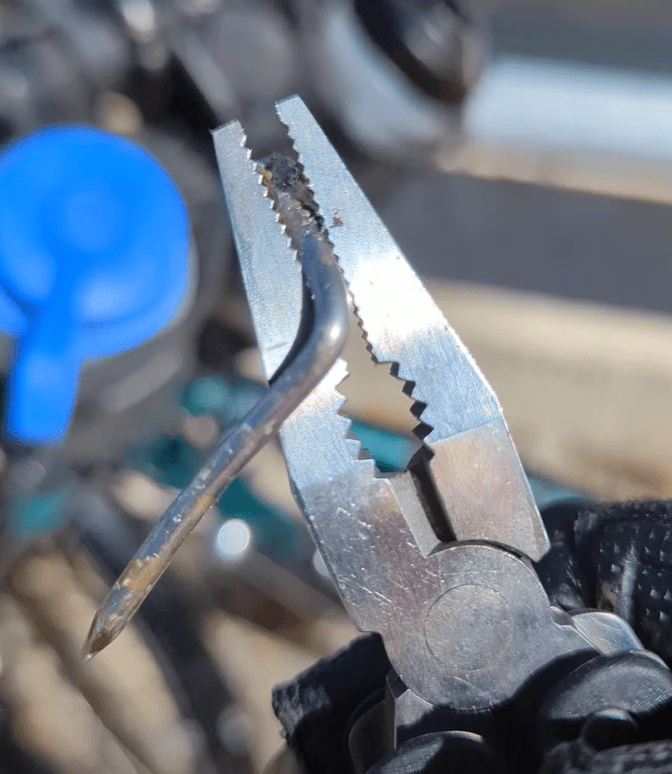
Under the sun’s glare I made an ambitious attempt to seal the inner tube’s gaping hole with a patch, which proceeded to blow off as soon the tyre was inflated. I had no choice but to dig out my spare inner tube. With everything reassembled and inflated, I was pleased to see no sign of the tube ballooning its way out of the tyre through the nail hole, but celebrations were short lived since the bike now bobbed up and down as it rode. There was a good reason for this new jiggle: a pebble wedged between the wheel rim and tyre, surreptitiously scooped up from the roadside gravel during the repair.
It’s a good example of how a shoddy repair can compound your grief, and why it’s worth investing in a bit of shelter from the midday sun when attempting any of the more profanity-inducing maintenance tasks.
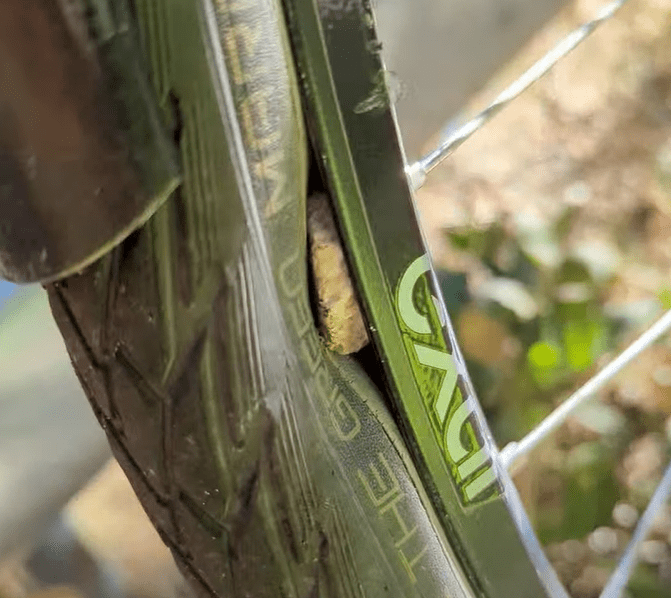
With the stone removed the buckle had softened, but not disappeared. I put this down to a buckled rim, which to rectify would be DIY job slightly beyond me. Fortunately the bike was perfectly rideable, and with nearly three hours passed since the nailing I carried on down the valley towards Tunceli.
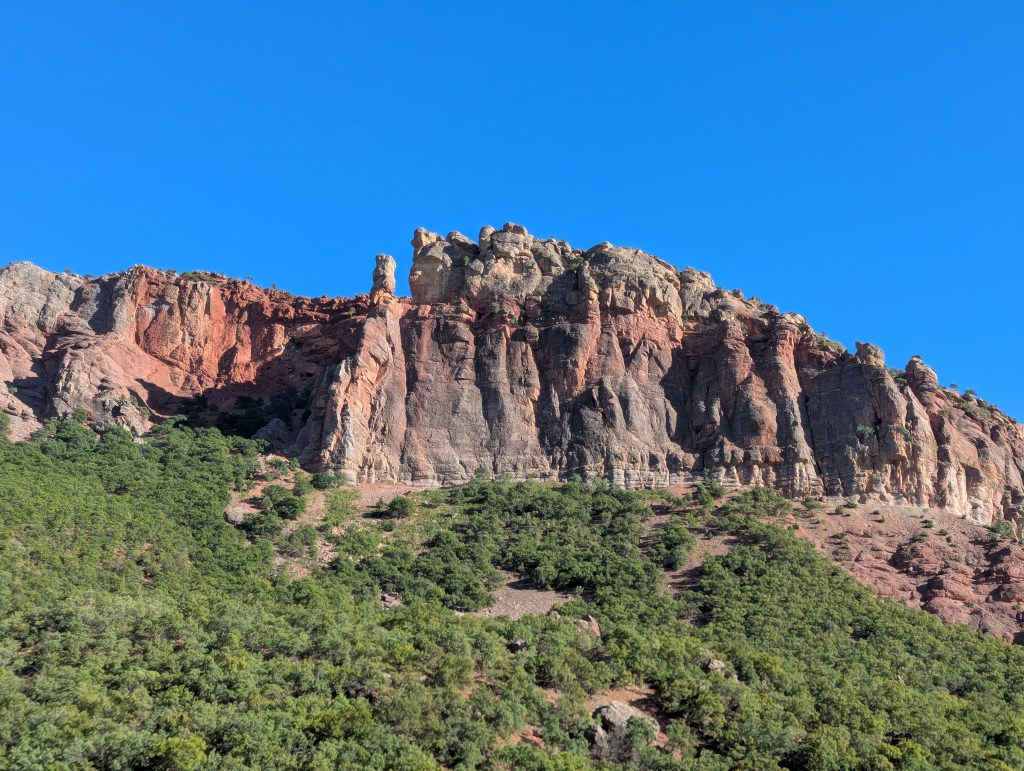
This is a truly spectacular road. The gorge is often narrow and steep, with characteristic rust-red geology on display throughout – well worth weaving into in any trans-Turkey cycling trip. Eventually the valley opens up into a more arable floodplain where the Pülümür and Munzur rivers meet, and where the city of Tunceli resides.
The Zaza Kurds of Dersim
On arrival by road into Tunceli, all vehicles are funnelled through the reinforced concrete Gendarmerie checkpoint, where every car, truck and bicycle comes under the watchful eye of armed guards. I expected to have to show my passport at least, but before I could stop the guard was nodding me through with a smile. Whatever they were looking for I clearly didn’t fit the profile.
The majority of locals here are Kurds who follow the Alevi faith and speak Zaza, achieving the trifecta of ethnic, religious and linguistic minority status in a country dominated by Turks, Turkish and Sunni Islam. Kurdish is an Iranian group of languages which does not technically include Zaza, yet the story of the Zazas is inextricably bound to the plight of Kurmanji-Kurdish speakers across Turkey; some of the most celebrated figures in modern Kurdish history were Zazas.
This province has a history of rebellion against Turkification, so much so that president Atatürk described the situation by 1936 as “Turkey’s most important internal problem”. In that same year the government introduced a law renaming the province from its original Kurdish, Dersim, to the modern Turkish Tunceli, a legal tactic employed on other non-Turkish place names across the country. In Dersim, a letter of protest was sent following a public meeting on the ‘Tunceli law’ which set off a violent chain of events to quell the rebellion: by 1938, a series of full scale military ground and air operations left thousands of Dersim’s Alevi Kurds dead, with more exiled.

With Armenian, Greek and Assyrian populations effectively eliminated from the new republic by the 1930s, it was the Kurds who remained as the main obstacle to the government’s ‘Turkification’ project. The goal was to transform the remnants of a once multi-cultural Ottoman society into a secular nation where speaking and identifying as Turkish was to be prioritised above all else. Whilst the specific policies of Turkification have morphed over time, it was just a few decades ago that having a conversation in Kurdish – even in the privacy of one’s own home – was an imprisonable offence.
The armed checkpoints coming in and out of Tunceli/Dersim allude to the city’s turbulent past and the fact the unresolved ‘Kurdish question‘ (i.e. the absence of any sovereign Kurdish state). In 1996 Zeynep Kınacı, a 23 year old Kurdish woman, had gathered to watch a Turkish military band as they marched through the city for a flag raising ceremony. Whilst Zaynep appeared to be heavily pregnant, her bulge was a bomb not a baby, detonating with lives of eight soldiers and her own; Zaynep was a member of the militant Kurdistan Worker’s Party (PKK) and immortalised as Turkey’s first suicide bomber.
Since a breakdown in ceasefire talks with Kurdish militants in 2015 Turkey has been ramping up counterinsurgency operations across the south-east region, where military checkpoints have become a key tactic in the containment and surveillance of suspected insurgents. A ceasefire was eventually declared by the PKK in March 2025 and the group announced their planned dissolution just four months prior to my arrival in town, so perhaps tensions were running fairly low by historical standards when I rolled in at the gate.
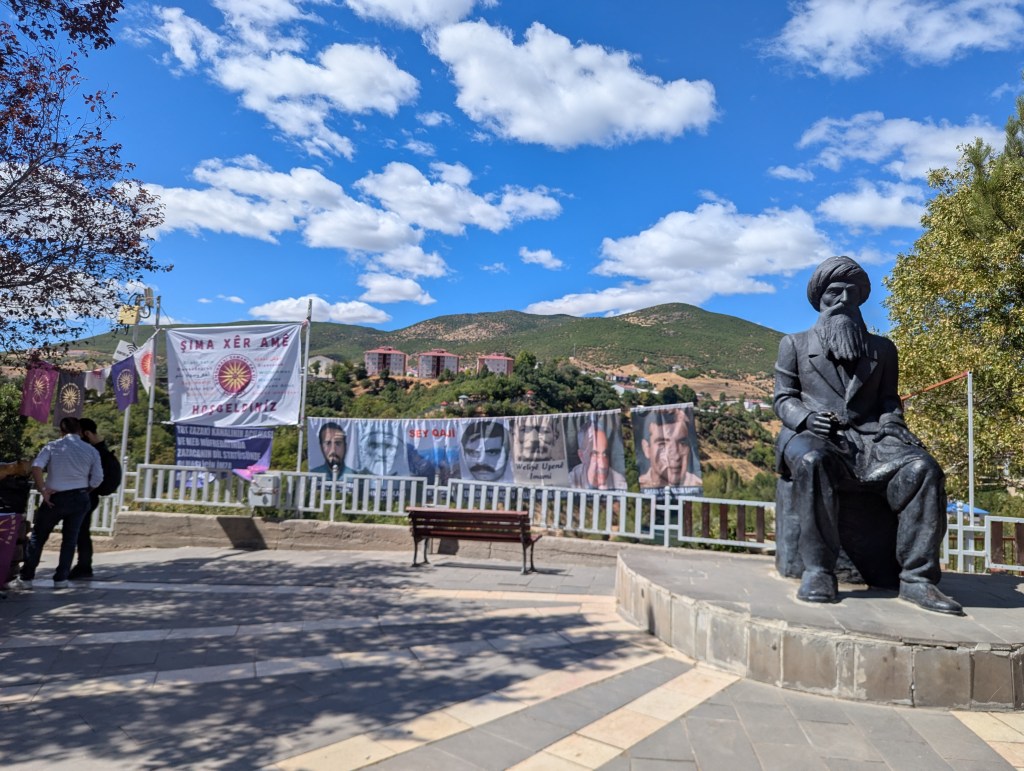
At first glance Dersim town centre is just like any other small city in Turkey. There’s a Ziraat Bank, a Turkcell phone shop, and the usual peppering of kebab shops, çay cafes and barbers. There was a relaxed atmosphere on the shaded tree-lined streets where most of the women wore their hair free and casual dress. Turkey is a long way from Saudi Arabia when it comes to women’s freedoms – but there was a tangible contrast emerging between the conservative Sunni Muslim city of Erzurum and Dersim, where the Alevi men and women come together to express their religion through music, song and dance in the local Cemevi…quite a departure from the solemn, gender segregated prayer rituals of the Mosque.
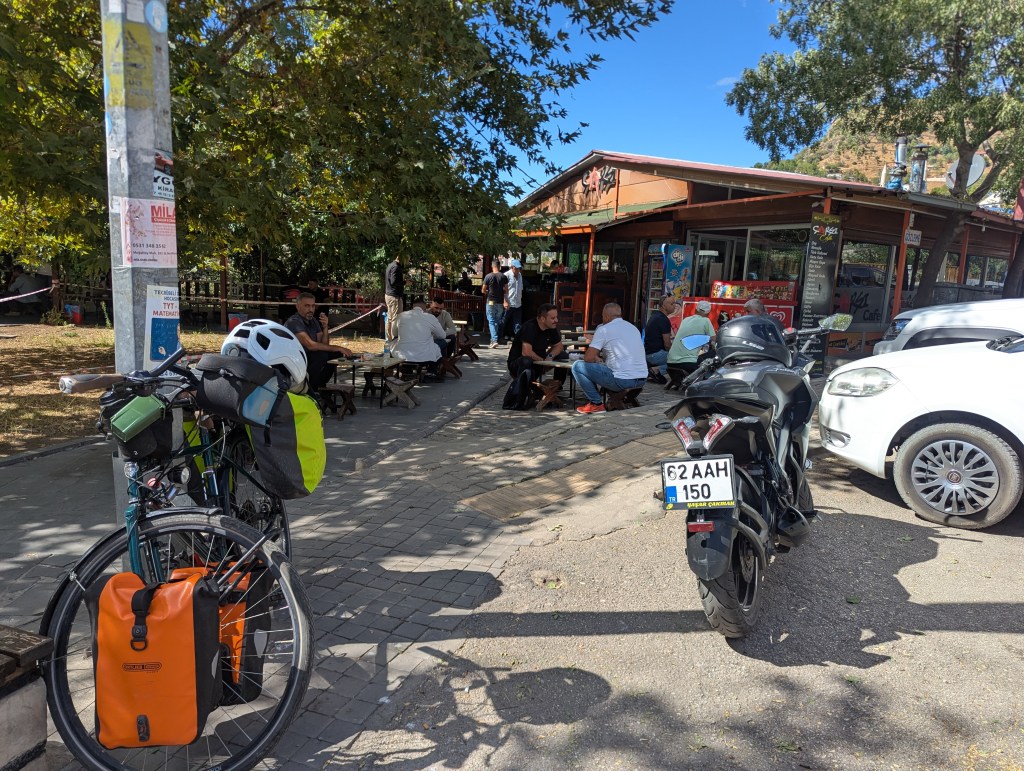
Seyid Riza Park occupies a small but peaceful corner of the town centre with impressive views over the forested Munzur River valley. The statue of Riza – an eminent Alevi Kurd who led the Dersim rebellion who was ultimately hanged by the government – whilst no sculptural masterpiece is symbolic for the fact it even exists in a country that tends to avoid the more painful areas of self-reflection. A street dog slept on a patch of shaded dirt to the sound of stringed folk music playing over a small PA system setup by a local political group as they gathered signatures for their cause: recognition of the Zaza language in official settings. It has never been revealed where Riza’s body was buried.
A local man brought me to the nearby Çarşı café for a cup of tea and a chat where it felt a bit like primary school parents evening sat on our one foot tall chairs. The caffeine kept flowing when I wandered up to the 2nd floor balcony of Goman’s Cafe for a coffee: business was quiet, which gave the manager – an elegant woman around five years my senior with long black hair and a wry smile – latitude to sit with me and smoke cigarettes whilst we quizzed each other in her broken English and my decimated Turkish. My host was a reminder that not everyone in Dersim is Kurdish, but the fact this was a café-bar serving alcohol being run by a woman alludes to the liberal inclination of this city. We snacked on a few small fragments of fried bread cooked by her mother, leftovers from a batch shared amongst the local community that morning.
My time in Dersim was brief, spread over an afternoon and morning with the intervening evening spent at a riverside picnic spot a few miles up the Munzur River valley. The site was patrolled by street dogs who made sure to bark at every passing vehicle but then immediately capitulated to anyone entering the site, to my relief. There were a few scraggy looking tents scattered around the site with camping chairs and campfire pits, but they seemed to be long abandoned, leaving just me, a couple of night fishermen, the dogs, and the perpetual churn of white water. When ‘nature called’ the next morning, with a lack suitable toileting spots along the camping area, I resolved to scramble up the most treacherously steep and oppressively hot roadside embankment in all of east Anatolia, where the earth was so dry it resembled solid rock; the slope would have been challenging enough to traverse (and dig a hole into…) without being on the verge of a catastrophic ‘code brown’ event.
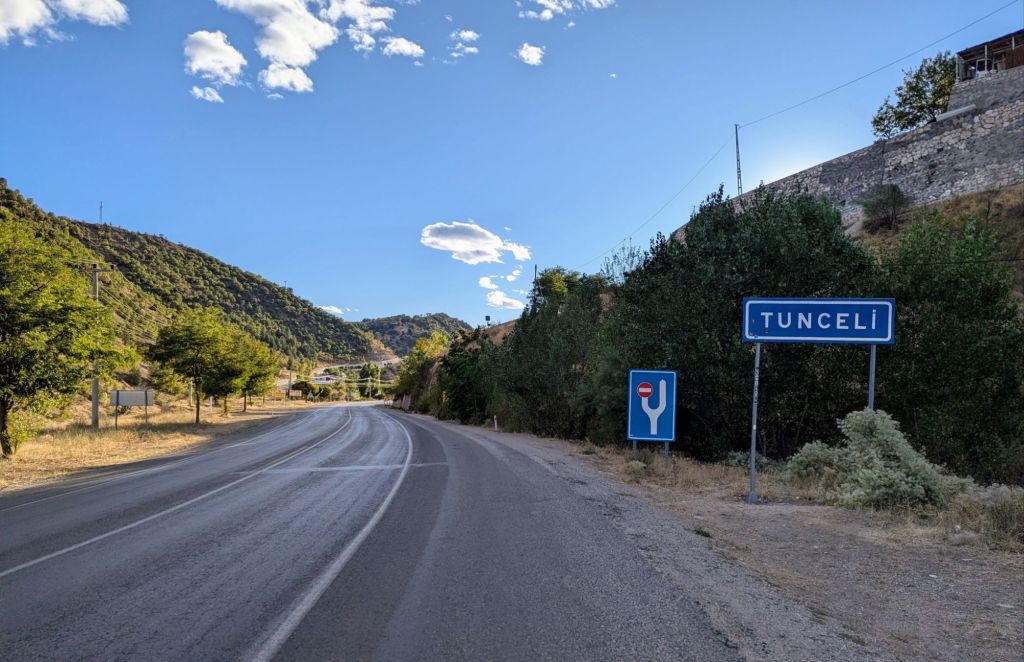
There is a serene quality to the red rock cliffs and green forested valleys of Dersim, whose most elderly residents were young children hiding amongst the trees when the soldiers and bomber aircraft arrived almost 90 years ago. The political debate will go on about whether the 1938 brutalities constituted genocide: if the goal was annihilation of the Alevi Zaza Kurds, then it must ultimately have been a failure. The name is Tunceli on paper, but in spite of the oppression there remains a thriving and proud Zaza community in these valleys for whom it will always be Dersim, whatever the sign says.
——————————–
PHOTOGRAPHY: Erzurum to Dersim
 The Cycling Brit
Leave a comment