
There will be no shortage of royal hangovers the morning after King’s Day, but the price of beer had done a good job in limiting my own consumption and I even managed to pack up and set off in good time. The plan was to try and join my pre-planned route in Flevoland, but to do this I would need to cross the body of water that separates Holland from the north-eastern Dutch provinces.

(credit: Wikipedia)
I assumed this body of water was a large tidal bay crossed by a couple of impressively long road bridges. But the Dutch being Dutch, these roads are not bridges but dams: they form part of the Zuiderzee Works that have totally transformed this landscape over the 20th century. My crude understanding is the dam provides a barrier to protect the area from flooding by the North Sea, whilst also turning the bay into a freshwater lake that can be drained at low tide. This ability to drain water logged areas has given birth to significant areas of brand new land – so called ‘Polders’ – one of which is Flevoland where I was heading.
The continued sunny weather brought the locals out to enjoy their favourite Sunday morning waterside activities along the winding cycle path that followed the shore of the Markermeer lake, which was now glistening in the midday sun. Odd to think that if the proposed Markerwaard polder had been built and the lake was fully reclaimed as originally planned, there would have been no waterside left for these people to enjoy. As it happens, the NIMBYs of Hoorn are a formidable bunch and the battle was won to protect their waterside amenities – the idea was scrapped in 2003 after a century in the planning system. Typically a sea view offers reliable protection against development encroaching your backyard…not in the Netherlands!
Upon arrival at the entrance to the dam that splits the Markermeer and IJsselmeer I snook into a museum toilet to top up my water and caked myself in factor 50 suncream, there would be virtually no shade for the next 26km so the protection was needed. Except it wasn’t the sun that was about to subject me to torture but hoardes of midges, strung out in long black clouds along the waterside cycle path. My sunglasses protected from direct eyeballs strikes, but they seemed to ricochet their way in through the open sides. The hair on my arms and legs quickly became saturated with the corpses of fallen flies, which had either exploded on impact or dissolved in the toxic mass of hair, suncream and crystallised sweat salt.
I tried ducking my head, weaving, and even swearing at them but it was futile, I needed a better strategy. Not long after joining the cycle path I passed a man with a road bike who had stopped for a toilet break (no. 1); after battling through several kilometres of midge clouds the man caught up with me and overtook on the left hand side. This was my chance. I stamped on the pedals and managed to tuck in close behind the bigger man, whose large silhouette not only sheltered me from the plague of flies but also the mild-yet-irritating headwind that blew across the lake. The man glanced around to inspect the source of heavy breathing that was now following him – a sunbaked Brit covered in dead flies hauling a 46kg quite un-aerodynamic bicycle – and mercifully continued his 28km/h tempo which I could just about hold onto for a good chunk of the dam.
Eventually the flat road briefly ramped up to a small gradient as we crossed a channel and my human shield pedalled away towards the horizon. Thankfully the flies had now largely dispersed, but there is still something quite soul destroying about cycling along a very long, straight, flat road – the scenery becomes static and unchanging, with only the occasional seabird breaking the monotony. People complain about riding up hills on bicycles, but at least your legs get a rest on the descent, endlessly flat roads can feel relentless – and there would be plenty more in this part of Europe.
Don’t tread on the tulips
The thing about a dijk is they are necessarily quite tall structures, so I didn’t see much of Flevoland at first after joining the polder along the long straight road that runs along the lakeside. Upon crossing the Ketelbrug bridge I was finally on more conventional roads again, heading into the heart of (the slightly mushroom-shaped) Noordoostpolder.
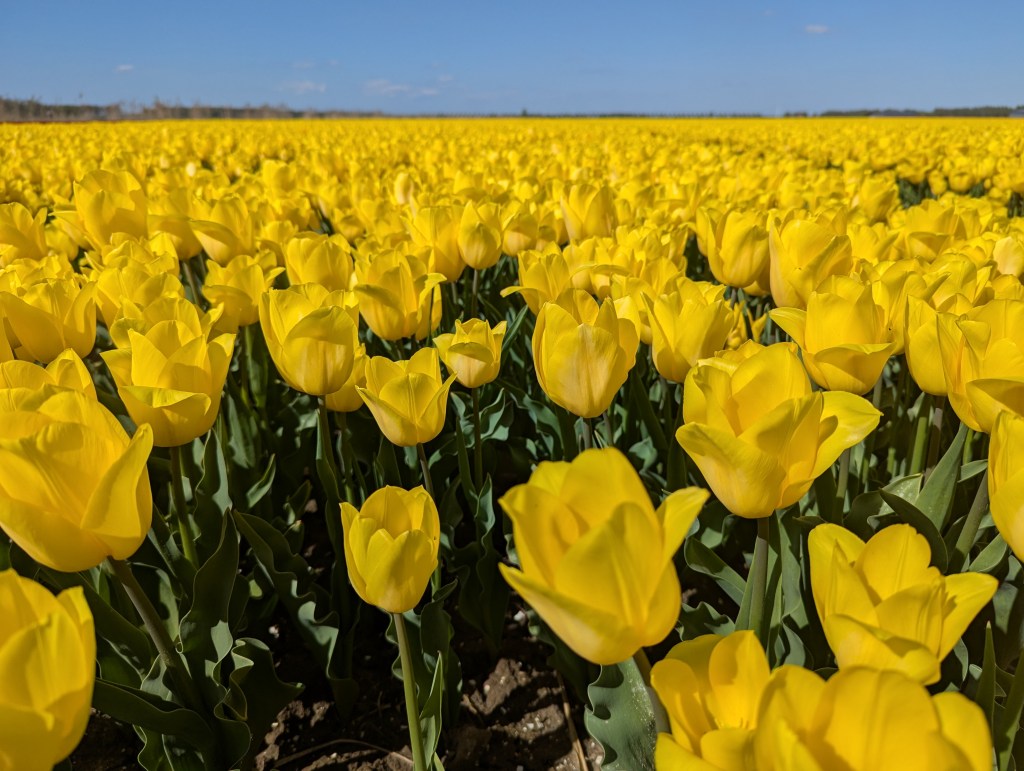
The odd field of tulips had appeared on previous days but these were under more overcast conditions. The fields beside me were suddenly beaming with saturated hues of red, yellow and white, like unmixed oil paint squeezed straight from the tube. By pure chance I had arrived more or less in peak tulip season. If you’re wondering what they do with millions of tulips upon harvest in late spring – although they may sell a few flowers they are mainly after the bulb. The flower head is removed and the plant diverts growth to the bulb instead, which is then dug up a few weeks later for sale or replanting.

The majority of tulip fields are protected from the public by an encircling ditch, but these particular fields – located along the signposted ‘tulpen route’ – had a small access bridge allowing for closer inspection. The farmer’s children were on duty to keep the tourists in check and bark instructions at those getting a little too close, led by the eldest boy who seemed to relish in this minor delegation of authority; I was sympathetic to the cause, but there was a mildly irritating style of execution, and I did wonder how easy it might be to pick up the little bureaucrat and hurl him into the nearby drainage channel (…don’t scrunch up your face, we’ve all met annoying kids before). But I was here to ride a bicycle not assault the local children, so onwards I went.

Into more natural surroundings
I took a brief pit stop at the edge of a car park in the uninspiring town of Emmeloord to ponder where I would stay for the night. After a toss up between a pricey hostel and rustic campsite I opted for the better value camping option, located in the National Park Weerribben-Wieden.
The natural habitat of this region is of course wetlands. The expansive, hedge-less agricultural fields were slowly replaced by water logged bogs, with many more woodland areas appearing along the roadside. After a few navigation blunders I found myself in the picture-postcard village of Kalenburg, with its idyllic modern looking houses lined up along the banks of a canal. Locals and tourists slowly chugged along in their pleasure boats, sipping wine in the evening sun and offering the occasional friendly wave, with some younger residents playing a game of ‘jump into the rubber dinghy’.
The campsite was small but picturesque, occupied by only a few couples (and their dogs) in motor homes. The owner was nowhere to be seen, so I picked a spot and got setup for the evening. I knew the site would be rustic but I did find the lack of showers to be a bit annoying given my sweaty condition after 116km of pedalling in the sun. The solution was obvious, change into the pair of orange swimming shorts (with saguaro cactus motif) I had brought and cool off in the canal, which had an access ladder leading right onto the campsite grounds. As you probably guessed, the water was excruciatingly cold, so I took a moment to compose myself whilst grasping onto the ladder until the cold shock response fizzled out, then had the briefest of swims and extracted myself back onto dry land. It wasn’t until my evening after-dinner walk that I discovered the shower block, equipped with hot water on the opposite side of the reception building.
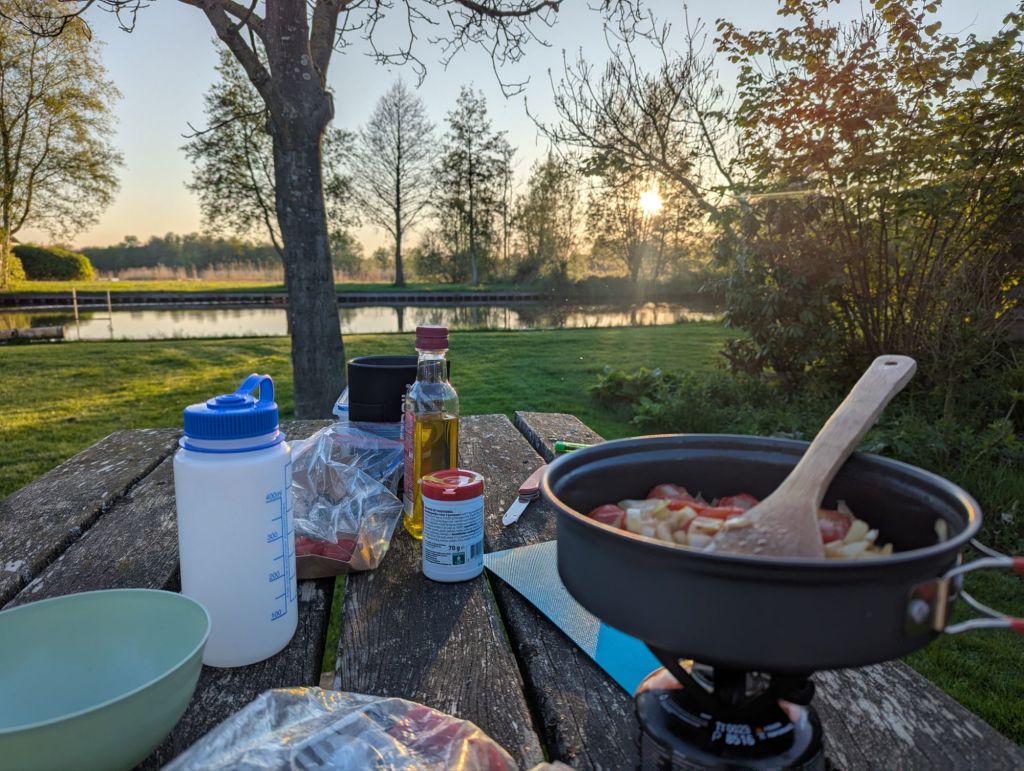
I would normally have been ready for a lie down after a long day in the saddle and late dinner, but I was struck by the chorus of peculiar sounds emanating from all around me, growing louder as the sun retreated. There seemed to be more bird life in this national park than all the other regions I had passed through put together, in particular ducks and geese; there would barely be a second pass without a honk, shriek or caww ring out. The amphibians joined in too – I can’t tell you if they were frogs or toads because I didn’t see a single one, but I was a trapped audience in the relentless symphony of croaking.
The windmill
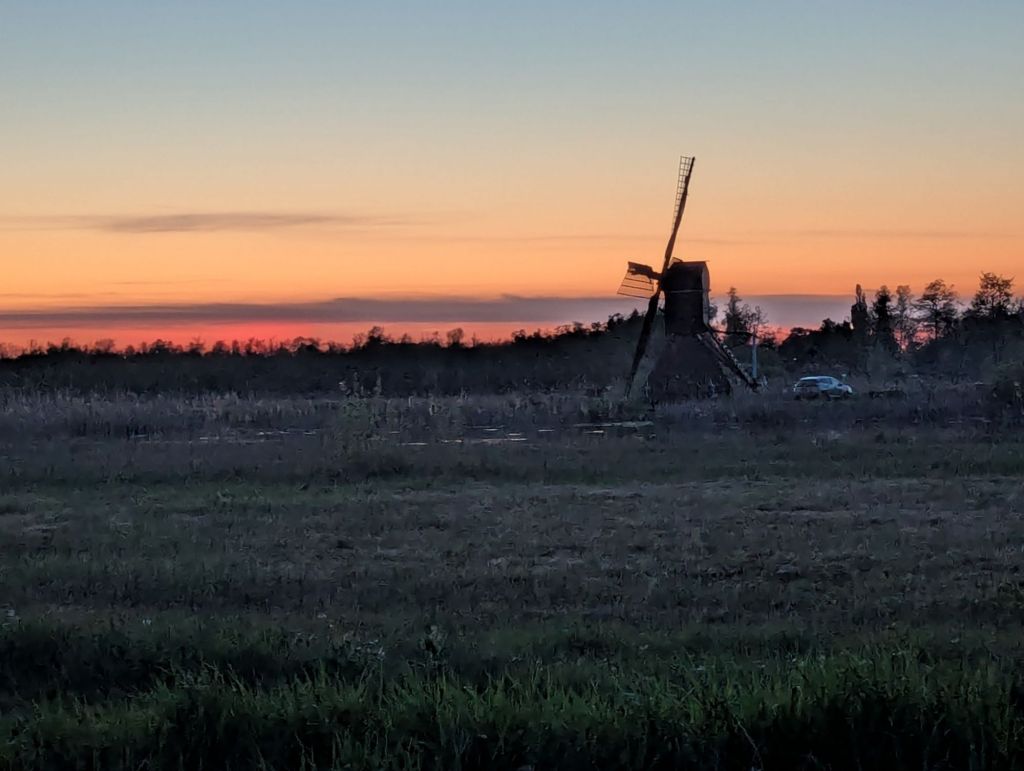
There’s no escaping them, the Dutch landscape is scattered with windmills. Well, not exactly: the majority nowadays are the familiar white turbines that generate electricity, but there are still plenty of old fashioned ones around that either mill grain or pump water, and they can be quite stunning.
So when I cycled beside an ‘open’ sign pointing towards a textbook example, and time on my hands, I parked up the bike and headed in.
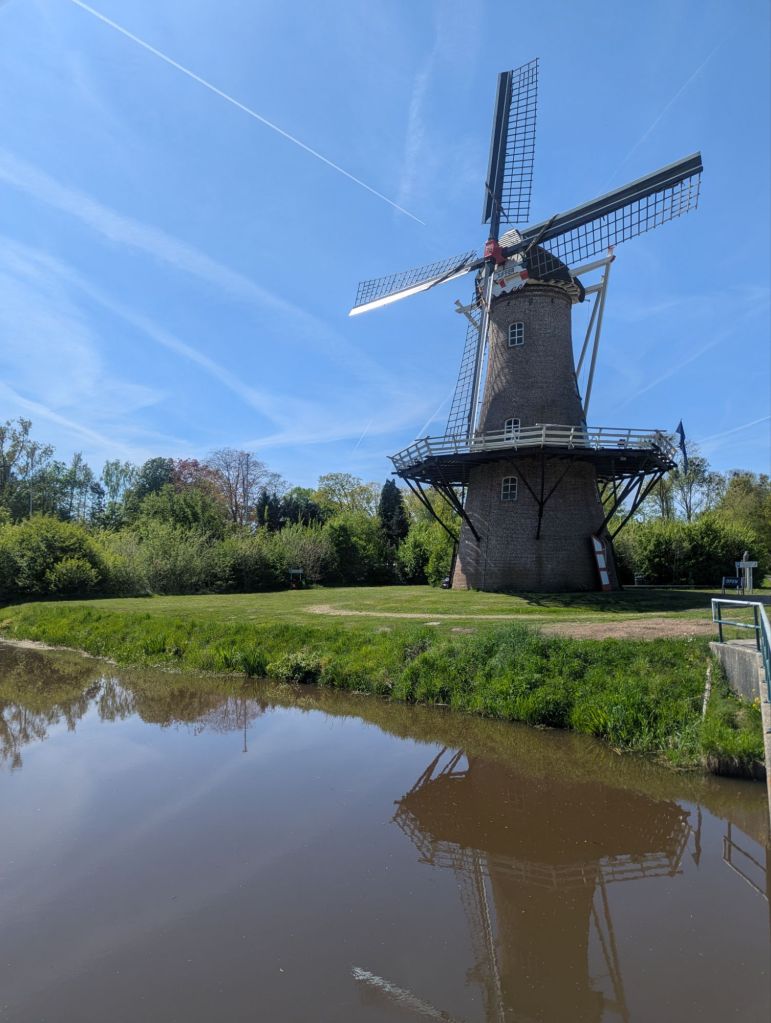
A Dutch ‘prijslijst’ of bready sounding products stapled onto the front door made me question whether it had been converted into a bakery, but it was soon clear the building had been restored into a living museum for public consumption. After climbing the steep stairs to level one I was met by a weather-beaten Dutchman of around 65 years, who had the rare distinction of speaking no English whatsoever, which as a fellow mono-linguist I respect greatly. He called up to his co-worker, a softly-spoken man of similar vintage with a short white beard, who climbed down a ladder from the second floor and I was treated to a personal tour of the mill. After talking through the history and inner workings, we headed out onto the sun-drenched balcony to release the brake – after a gentle nudge from his colleague the sails began to turn in the light breeze and the mill suddenly came to life.
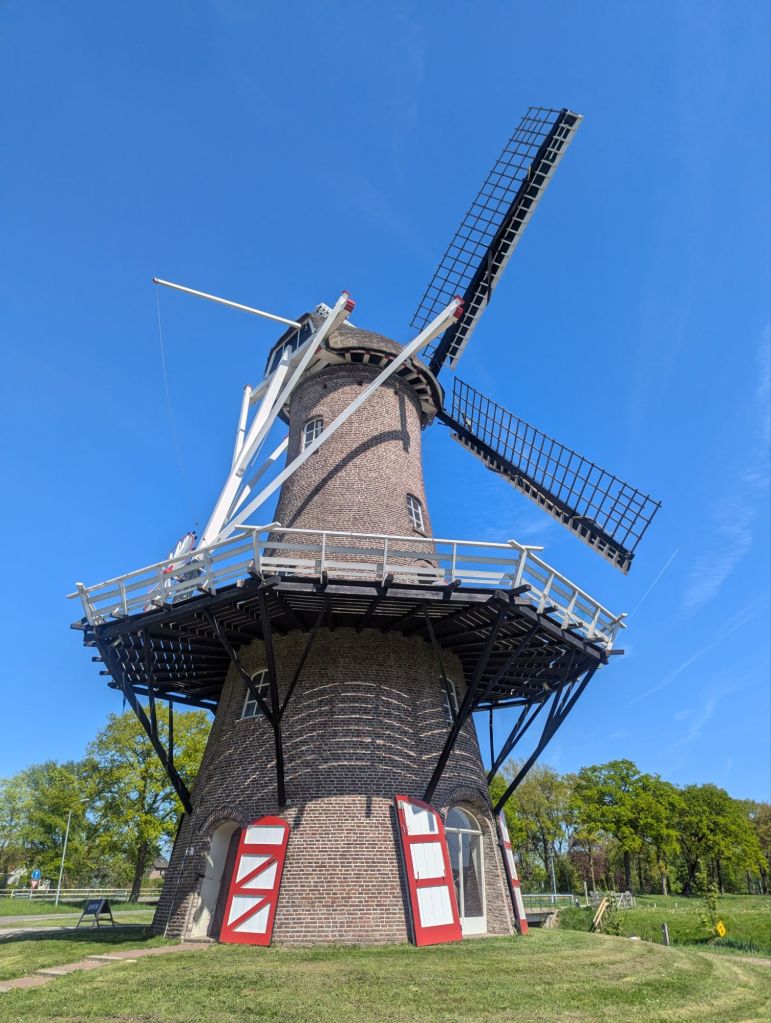
A bit like when steam railways still provide passenger services on heritage lines operated by keen volunteers, the windmill was being put to work by grinding grain, mainly for animal feed these days. What was nice about the experience was not so much the windmill but the two chaps operating it – they understood every little piece of that mill and how to maintain it, which follows a design changed very little since the 1600s. It is easy to see how practical knowledge can be lost when people like this weld their last rivet or mill their final grain of wheat without an apprentice to keep it all going for the next generation.
Pottering around inside a windmill felt like a fitting end to the Netherlands, but the time had come to move on and head for the border. Next up, Germany – a country that had barely registered in my mind when planning the trip.
PHOTOGRAPHY: Flevoland & north east Netherlands
 The Cycling Brit
Leave a comment